
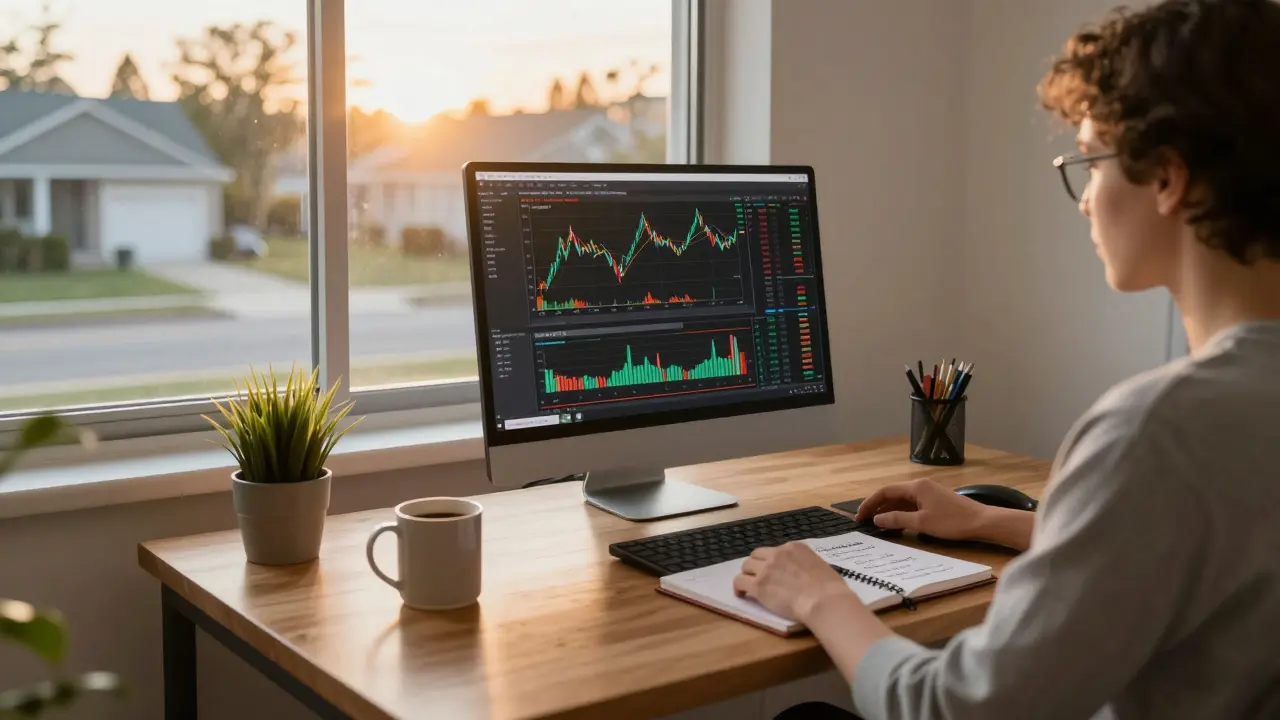
Most people think stock trading is for Wall Street brokers or rich investors with fancy desks and live tickers. But here’s the truth: if you understand how it works, stock trading can be one of the smartest ways to grow your money - not by gambling, but by making smart, repeatable choices.
Stock trading isn’t about luck - it’s about patterns
Every day, millions of people buy and sell stocks. Some lose money fast. Others build wealth slowly. The difference? The ones who win don’t chase hot tips or panic-sell when the market dips. They look for patterns. They track how companies perform over time, not just how their stock price moves on a single day.
Take Apple. In 2010, its stock traded around $30. By 2025, it hit $220. That’s not luck. That’s because Apple kept releasing products people wanted, made consistent profits, and reinvested in its future. If you’d bought $1,000 worth of Apple stock in 2010 and held it, you’d have over $7,300 today. Not because you traded every day - because you trusted the business.
Stock trading works best when you treat it like owning a piece of a real business, not a slot machine.
Start with what you know
Don’t jump into biotech stocks because a YouTube video said they’d explode. Don’t buy crypto because your cousin made a quick buck. Start with companies you already use or understand.
Do you shop at Target? You own a tiny part of Target every time you buy groceries. Do you stream shows on Netflix? You’ve already seen how their business model works. Do you use PayPal to send money to friends? That’s a financial tech company with millions of users.
These are your best starting points. You already know how these companies make money. You know if their products are reliable, if people keep using them, and if they’re growing. That’s more insight than most traders have.
Research isn’t about reading 50-page reports. It’s about asking: Do people keep coming back? Is this company making more money each year? Is it paying dividends or reinvesting to grow? If the answer is yes, you’re already ahead of 80% of traders.
Trading vs. investing: what’s the real difference?
People mix up trading and investing. They think if you buy a stock and sell it in a week, you’re a trader. If you hold it for five years, you’re an investor. That’s not the full picture.
A trader looks for short-term price movements - maybe a few hours, days, or weeks. They use charts, volume data, and news to time entries and exits. A true investor looks at the company’s value - earnings, debt, management, market position - and buys based on long-term potential.
Here’s the key: you don’t have to be one or the other. You can do both. But if you want to build real wealth, focus 80% on investing and 20% on trading.
Why? Because trading costs add up. Every time you buy or sell, you pay a fee. Even $5 per trade adds up to $500 a year if you trade 100 times. And taxes? Short-term gains are taxed at your full income rate. Long-term gains (held over a year) get a much lower rate.
Most people who trade daily lose money after fees and taxes. Most people who invest in solid companies and hold for years end up ahead.

How to pick your first stocks - a simple checklist
You don’t need a finance degree to start. Just use this four-point checklist:
- Revenue growth - Has the company increased sales every year for the last 5 years? Look for steady growth, not spikes.
- Profit margins - Are they making money after all costs? A net profit margin above 10% is a good sign.
- Low debt - Debt-to-equity ratio under 1.0 means the company isn’t relying too much on loans.
- Dividends or reinvestment - Does it pay shareholders or use profits to grow? Both are good. Avoid companies that burn cash.
Use free tools like Yahoo Finance or Google Finance. Type in a company name, click on the “Financials” tab, and scan these numbers. If three out of four check out, it’s worth a closer look.
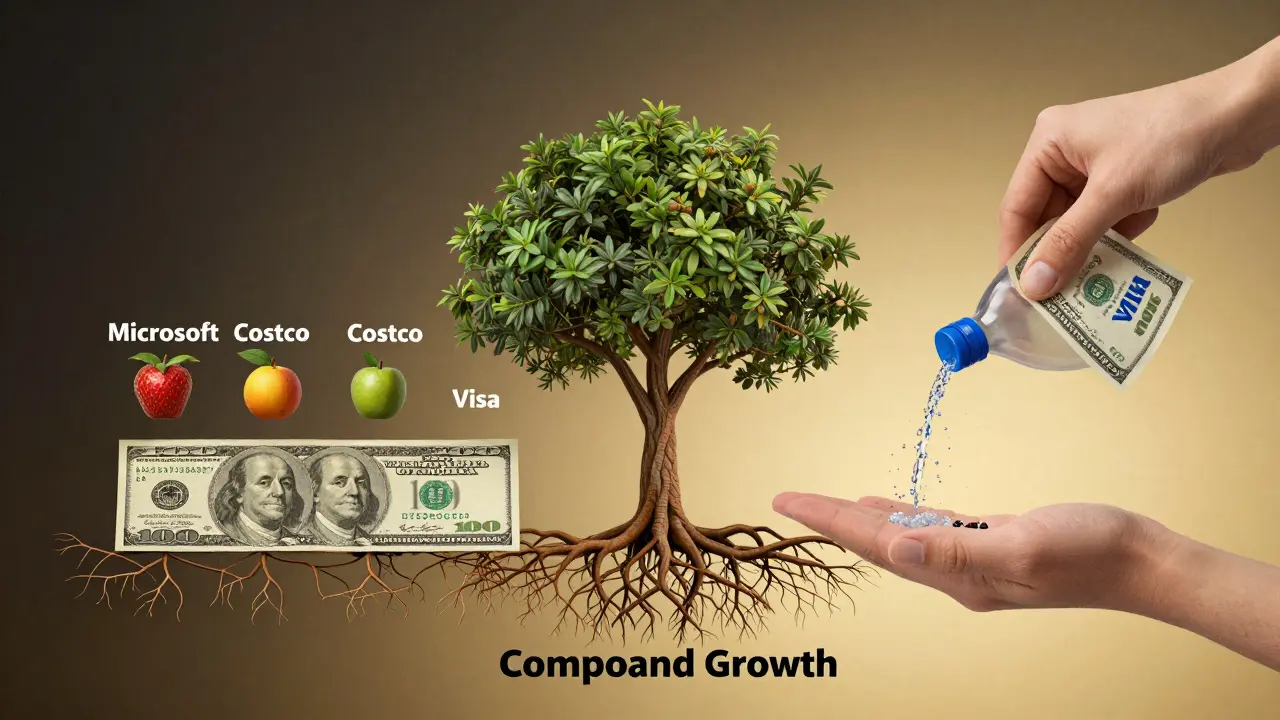
Examples from 2025: Microsoft, Visa, and Costco all fit this pattern. They’ve grown revenue, kept debt low, and made consistent profits. You don’t need to find the next Tesla. You need to find the next steady winner.
Set rules before you trade
Emotion kills returns. Fear makes you sell low. Greed makes you buy high. That’s why you need rules before you open your trading app.
Here’s what works:
- Never risk more than 2% of your total portfolio on one trade. If you have $10,000, that’s $200 max per stock. This keeps you alive when you’re wrong.
- Set a stop-loss. If a stock drops 10% from your buy price, sell it. No exceptions. This stops small losses from turning into big ones.
- Set a take-profit target. If a stock rises 20%, consider selling half. Lock in profit. Let the rest ride if you still believe in the company.
- Trade only on your schedule. Don’t watch the market all day. Check once a week. Most price swings are noise.
These rules aren’t magic. They’re just guardrails. They keep you from acting like a human emotion machine.
Start small. Stay consistent.
You don’t need $10,000 to begin. You need $100 and patience.
Many brokers now let you buy fractional shares. That means you can buy $25 worth of Amazon stock, even if one full share costs $3,500. Use this. Start with $50 a month. Buy one stock. Hold it. Then add another next month.
Over 12 months, you’ll own 12 different companies. Over 5 years, you’ll have a diversified portfolio. Over 10 years, you’ll have real wealth.
Compound growth is the silent engine behind most rich people. It doesn’t need big wins. It just needs time and consistency.
What to avoid at all costs
Here are the three biggest traps:
- Day trading like a pro - Only 1 in 10 day traders make money long-term. The rest lose more than they gain. Don’t be one of them.
- Following influencers - If someone on TikTok says “BUY NOW,” they’re not your financial advisor. They’re trying to get clicks.
- Chasing “hot” stocks - GameStop, AMC, Dogecoin - these aren’t investments. They’re speculation. They rise because people are excited, not because the business is strong.
Stay away from hype. Stick to businesses that have been around for a decade, make money, and have loyal customers.
What happens after you start?
After your first year, you’ll notice something: the market will feel less scary. You’ll understand why prices move. You’ll stop reacting to headlines. You’ll start making decisions based on data, not fear.
You’ll also realize that stock trading isn’t about getting rich overnight. It’s about building a life where your money works for you - while you sleep, work, or take vacations.
That’s the real win.
Final thought: Your money is your most powerful tool
Most people spend their money. A few save it. The smartest invest it - and learn how to trade it wisely.
Stock trading isn’t about being a genius. It’s about being patient, disciplined, and consistent. You don’t need to time the market. You just need to stay in it.
Start today. Not tomorrow. Not next month. Today. Buy one share. Learn one thing. Hold it. And keep going.

kelvin kind
January 18, 2026 AT 01:38Been doing this for 8 years. No fancy tools, just Apple, Visa, and Costco. Still holding. Market’s noisy, but the businesses aren’t.
Ian Cassidy
January 18, 2026 AT 21:51Yeah, but let’s be real - most retail traders are just alpha-seeking monkeys with Robinhood open 24/7. The 80/20 rule here is spot on. Investing = compounding. Trading = gambling with a spreadsheet.
Sarah McWhirter
January 19, 2026 AT 13:25Interesting how you frame this like it’s some secret wisdom… but have you ever considered that the whole system is rigged? The Fed prints money, hedge funds front-run retail, and you’re told to ‘buy the dip’ while they sell the top? 😏
Apple’s stock went up because they’re a monopoly with 1.2 billion devices in people’s pockets. That’s not investing - that’s owning a digital toll booth. And you’re just the toll collector.
Ananya Sharma
January 19, 2026 AT 22:44Oh please. You’re romanticizing capitalism like it’s a yoga retreat. Revenue growth? Profit margins? Please. Most of these ‘stable’ companies are just tax-avoiding behemoths that outsource labor, crush small competitors, and buy politicians. Costco? They pay their warehouse workers minimum wage and call it ‘employee-friendly.’ Visa? They skim 2% off every transaction in the global economy. This isn’t investing - it’s complicity. And you call it wisdom? Pathetic.
Chris Heffron
January 21, 2026 AT 21:47Love the checklist. Simple, clear, no fluff. 👍
Also, fractional shares are a game-changer. My first stock was $17 of Netflix back in 2020. Still holding. No drama. Just growth.
Adrienne Temple
January 22, 2026 AT 14:10Thank you for this. I’m 52 and just started with $50/month. I bought one share of Microsoft with my first deposit. Didn’t know what EPS meant, but I knew I used Windows and Teams every day. Now I check my portfolio once a week. It’s calming. Like gardening with money. 🌱
Sandy Dog
January 22, 2026 AT 20:59Okay but what if I told you… the stock market is just a giant game of musical chairs where the music is printed by the Fed and the chairs are bought with your student loan debt? 😭
And you’re sitting there like ‘oh I bought 10 shares of Visa’ like it’s a spiritual awakening? Honey. I cried when my crypto dropped 80%. I don’t even know what I’m doing. But I’m here. And so are you. We’re all just trying not to die broke. 💔💸
Nick Rios
January 23, 2026 AT 18:25I get where you’re coming from. I used to trade daily. Lost money. Got stressed. Started investing in what I understood. Now I sleep better. Not rich, but not anxious either. That’s win enough for me.
Amanda Harkins
January 25, 2026 AT 02:43It’s weird how we turn finance into this moral test. Like if you don’t follow these rules, you’re ‘lazy’ or ‘gullible.’ But what if you just… don’t care? What if your money’s not supposed to grow? What if you’d rather spend it on travel, or therapy, or pizza? Not everyone’s playing the same game.
Jeanie Watson
January 25, 2026 AT 22:15Same. Bought $200 of Amazon in 2021. Watched it crash. Watched it climb. Didn’t touch it. Now it’s worth $700. I didn’t even remember I owned it until last month. That’s the point, right? Don’t look. Just hold.
Jessica McGirt
January 26, 2026 AT 13:05This is one of the most balanced, practical pieces on personal investing I’ve read in years. Clear structure, no jargon, no hype. The four-point checklist is gold. Thank you for writing this with such clarity and restraint.
Donald Sullivan
January 26, 2026 AT 14:48You’re all just kissing the ass of Wall Street. The system is designed to make you think you’re in control. You’re not. You’re a data point. Your ‘patience’ is their profit margin. Wake up.
Tina van Schelt
January 27, 2026 AT 20:04I used to think trading was about charts and tickers. Then I started noticing how my niece’s favorite sneaker brand kept selling out - and bought a few shares of Nike. Didn’t even know what a P/E ratio was. Just saw people wearing the shoes. That’s my ‘research.’ Turns out, it works. 🤷♀️
Zach Beggs
January 29, 2026 AT 09:53Agreed. The real win isn’t the money - it’s the peace of mind. No more checking prices every 10 minutes. Just… knowing you’re doing something right.
Aaron Elliott
January 30, 2026 AT 01:38While the sentiment expressed herein is ostensibly laudable, one must interrogate the underlying epistemological assumption: that market efficiency can be reliably approximated by retail investors utilizing publicly available financial metrics. The empirical literature, particularly Fama and French (1992) and more recently Barber & Odean (2001), demonstrates conclusively that retail trading activity is systematically correlated with negative alpha after transaction costs. Thus, the ‘simple checklist’ proposed, while psychologically comforting, constitutes a form of cognitive bias mitigation rather than a robust investment strategy. One is reminded of the Dunning-Kruger effect - wherein the least competent are most confident in their competence.