

Most people think investing is for the rich. That’s a myth. The real secret isn’t having a lot of money to start-it’s starting with what you have and letting time do the work. If you’re 25 and put $200 a month into a low-cost index fund, you could have over $500,000 by 65. If you wait until 35? You’d need to save nearly double that each month to catch up. This isn’t magic. It’s math. And it’s the only thing that actually builds lasting wealth.
What Investments Actually Do
Investing isn’t gambling. It’s not buying memes or crypto because someone on TikTok said it’ll 10x. Real investing means putting your money to work so it earns more money over time. That’s it. You buy assets-stocks, bonds, real estate-that generate returns. Those returns get reinvested. And over decades, that compounding effect turns small, regular contributions into life-changing sums.
Take the S&P 500. Since 1957, it’s returned about 10% annually on average, including dividends. That’s not a guess. That’s data from the Federal Reserve and Vanguard. If you’d invested $10,000 in 1980, you’d have over $1.1 million today. No trading. No timing. Just holding.
How to Start Without Knowing Everything
You don’t need a finance degree. You don’t need to read earnings calls. You don’t need to pick the next Apple. Start simple:
- Open a brokerage account at Fidelity, Vanguard, or Charles Schwab. All have $0 fees and no minimums.
- Set up automatic transfers. Even $50 a week. Don’t think about it. Just let it happen.
- Buy a total stock market index fund like VTI or VTSMX. That’s one fund that owns thousands of U.S. companies. Done.
That’s it. You’re now an investor. The rest is noise. Most people lose money because they chase trends, panic-sell during downturns, or pay too much in fees. You won’t if you stick to this.
The Three Types of Investments That Actually Work
Not all investments are equal. Some are flashy. Some are safe. Only three deliver real results over time:
1. Index Funds and ETFs
These are baskets of stocks or bonds that track a market. They’re cheap, diversified, and hands-off. A total market ETF like VTI costs just 0.03% per year. That’s $3 for every $10,000 you invest. Compare that to an active mutual fund charging 1.5%-you’d pay $150 for the same $10,000. Over 30 years, that difference alone can cost you over $300,000.
2. Real Estate (Through REITs or Rental Properties)
You don’t need to buy a house to own real estate. Real Estate Investment Trusts (REITs) let you invest in apartment buildings, warehouses, or shopping centers with as little as $100. REITs pay high dividends-often 4% to 6%-and have historically matched stock market returns with less volatility. If you want to go hands-on, owning one rental property in a growing city can generate steady cash flow and long-term appreciation.
3. Your Own Skills and Business
This is the most overlooked investment. Learning a high-income skill-coding, copywriting, digital marketing, accounting-can increase your earning power more than any stock. A $500 course that helps you land a $15,000 raise is a better return than any mutual fund. Starting a side hustle? That’s not just income-it’s an asset you own. A blog, YouTube channel, or online course can keep earning long after you stop working.
What to Avoid at All Costs
There are traps everywhere. Don’t fall for them:
- Day trading: 90% of day traders lose money. The ones who win are the brokers collecting commissions.
- High-fee mutual funds: If fees are over 1%, you’re being taken for a ride. Index funds crush them over time.
- Get-rich-quick schemes: Crypto pumps, NFT flips, binary options-they’re designed to take your money, not grow it.
- Buying insurance as an investment: Whole life policies, annuities with surrender charges-they’re expensive and inflexible. Buy term life insurance and invest the difference.
There’s no shortcut. The path to wealth is slow, boring, and repeatable.
How Much Do You Need to Start?
Less than you think. You can start with $10. Robinhood, M1 Finance, and Acorns let you invest spare change. But here’s the truth: the amount doesn’t matter as much as consistency. Someone who invests $100 a month for 40 years will end up richer than someone who invests $1,000 a month for 15 years. Why? Time. Compound growth rewards patience.
Use this rule: Save 15% of your income. If you make $50,000 a year, that’s $6,250. Split it: $4,000 into your 401(k), $2,000 into an IRA, $250 into a brokerage account. That’s it. You’re ahead of 90% of Americans.
How to Stay on Track
The biggest threat to your wealth isn’t the market. It’s you. Emotions. Fear. Greed. FOMO. Here’s how to stay calm:
- Check your portfolio once a quarter. Not daily. Not weekly. Once every three months.
- Ignore the news. Markets go up and down. The 2008 crash? The 2020 pandemic drop? The 2022 bear market? All recovered. And if you held on, you made money.
- Automate everything. Set up recurring deposits. Let your money grow while you sleep.
- Rebalance once a year. If one asset grows too big, sell a little and buy more of the others. Keep your risk level steady.

What Does a Real Wealth-Building Portfolio Look Like?
Here’s a simple, proven structure for someone under 40:
| Asset Class | Allocation | Example Fund |
|---|---|---|
| U.S. Stocks | 60% | VTI (Vanguard Total Stock Market ETF) |
| International Stocks | 20% | VXUS (Vanguard Total International Stock ETF) |
| Bonds | 15% | BND (Vanguard Total Bond Market ETF) |
| Real Estate (REITs) | 5% | VNQ (Vanguard Real Estate ETF) |
For someone over 50, shift more into bonds. For someone in their 20s, you can go 90% stocks. The key isn’t perfection-it’s staying consistent. Rebalance once a year. That’s it.
Why Most People Never Get Rich
It’s not because they’re unlucky. It’s because they think they need to know more. They wait for the perfect time. They read 10 books. They watch 50 YouTube videos. They compare portfolios. They delay. Meanwhile, inflation eats away at their cash. Their savings account earns 0.5%. The market goes up 8%.
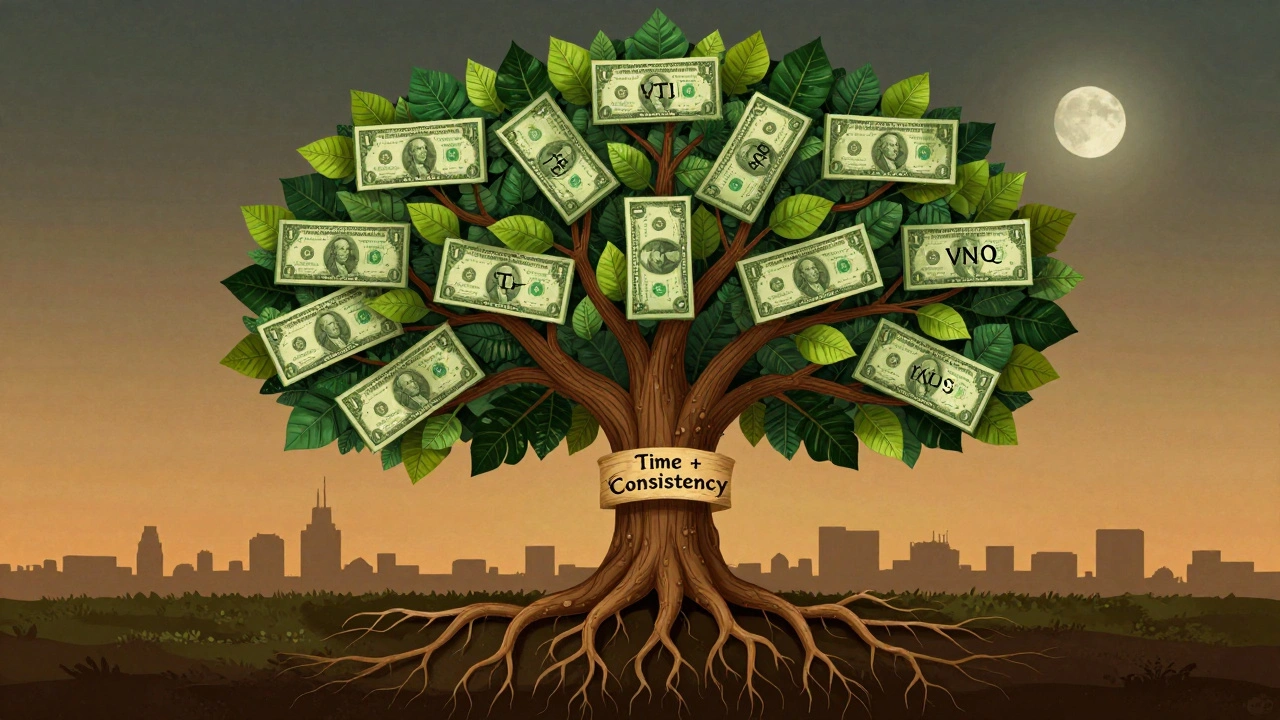
The richest people didn’t win by being smarter. They won by starting earlier and staying in longer. They didn’t time the market. They timed their consistency.
Where to Go From Here
You don’t need to do everything tomorrow. Start with one step:
- Open a brokerage account today. It takes 10 minutes.
- Set up a $25 automatic transfer from your checking account.
- Buy VTI. That’s it.
Next month, increase it to $50. Then $100. Then $200. Keep going. Don’t wait for more money. Start with what you have. The future you is already waiting. And it’s richer because you started today.
Do I need a financial advisor to invest?
No, not if you’re willing to learn the basics. Most advisors charge 1% of your portfolio each year. For a $100,000 portfolio, that’s $1,000 annually. You can get the same results by using low-cost index funds and doing your own simple rebalancing. Only hire an advisor if you have complex needs-like estate planning, taxes over $250,000 in income, or multiple businesses.
Is it too late to start investing if I’m over 40?
Never too late. Even starting at 45, investing $500 a month at 7% annual returns will get you over $400,000 by 65. That’s not retirement luxury, but it’s security. The goal isn’t to catch up to someone who started at 20. It’s to build something better than what you have now.
Should I invest in Bitcoin or crypto?
Only if you can afford to lose it. Crypto isn’t an investment-it’s speculation. It has no cash flow, no earnings, no intrinsic value. If you want exposure, limit it to 1-2% of your portfolio. Never use borrowed money. Never put your emergency fund into it. Treat it like a lottery ticket, not a retirement plan.
What’s the best way to invest for retirement?
Max out your 401(k) if your employer matches-that’s free money. Then contribute to a Roth IRA ($7,000 in 2025). After that, invest in a taxable brokerage account. Use index funds. Keep fees low. Don’t touch it until you’re 59½. The power of tax-free growth in a Roth IRA over 30 years can turn $5,000 a year into over $1 million.
How do I know if I’m investing enough?
If you’re saving 15% of your income and investing it in low-cost index funds, you’re doing better than 90% of Americans. If you’re saving 20% or more, you’re on track to retire early. The real question isn’t ‘how much?’-it’s ‘am I consistent?’ If you’re skipping months or changing strategies every time the market dips, you’re sabotaging yourself.
