

Most people think investing is for rich folks with fancy desks and stock tickers on their walls. That’s not true. Investing is just putting your money to work so it grows over time-no magic, no insider secrets, just math and patience. If you’re starting with $50 or $500, you’re already ahead of the 70% of adults who don’t invest at all. The goal isn’t to get rich overnight. It’s to build something steady, something that outlasts your paycheck.
Why investing beats saving alone
Saving money in a checking or savings account feels safe. But here’s the problem: inflation eats away at it. In 2025, the average U.S. inflation rate is 3.1%. That means if you keep $10,000 in cash under your mattress, in 10 years it will only buy what $7,400 buys today. Meanwhile, the S&P 500 has returned about 9.5% annually over the last 40 years-even after crashes and recessions. That’s not a guarantee, but it’s a pattern.Investing isn’t gambling. It’s about owning pieces of real things: companies, buildings, crops, even clean energy projects. When those things grow, so does your money. The earlier you start, the more time your money has to grow. A 25-year-old who invests $300 a month will have over $600,000 by 65, assuming a 7% average return. Someone who waits until 35? Just $280,000. That’s a $320,000 gap from 10 years of delay.
How to start with zero experience
You don’t need a finance degree. You don’t need to pick individual stocks. Here’s the simplest path:- Open a brokerage account with a low-cost provider like Fidelity, Charles Schwab, or Vanguard. These platforms have $0 fees and no minimum balances.
- Choose a target-date fund. It’s a single fund that automatically adjusts its risk level as you get closer to retirement. For example, a 2065 target-date fund is aggressive now, then slowly shifts to safer assets over time. You just pick the year closest to when you plan to retire.
- Set up automatic transfers. Even $50 a week adds up. Automate it so you never have to think about it.
That’s it. You’ve started. No stock picking. No market timing. No stress.
What you actually own when you invest
When you buy shares in a mutual fund or ETF, you’re not buying a piece of paper-you’re buying a slice of real businesses. For example:- Apple: Makes phones, computers, services
- Microsoft: Powers software for businesses and homes
- Amazon: Runs logistics, cloud computing, retail
- Johnson & Johnson: Produces medicines and health products
These aren’t random guesses. They’re companies that have been around for decades, earn money consistently, and pay dividends. Target-date funds hold hundreds of these companies at once. You’re not betting on one. You’re betting on the whole economy.
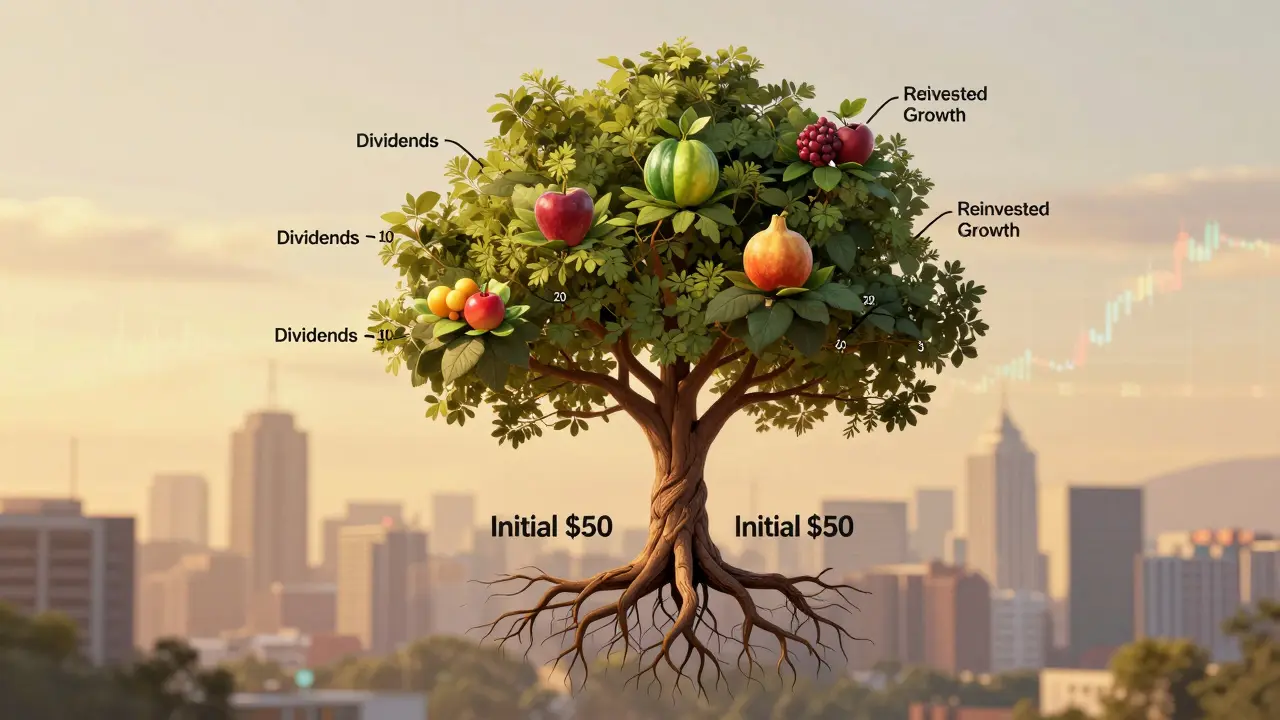
Dividends are cash payments companies give shareholders. Reinvesting them means buying more shares automatically. Over time, this turns small payments into big growth. A $10,000 investment in the S&P 500 in 1990, with dividends reinvested, became over $200,000 by 2025. Without reinvesting? Just $50,000.
Common mistakes beginners make
Here’s what trips up most new investors:- Trying to time the market - Waiting for the "right time" to invest. The truth? No one knows when the bottom is. The best time to start was 10 years ago. The second best time is today.
- Chasing hot stocks - Buying Tesla because it went up 500% last year, or GameStop because it’s trending. These are lottery tickets, not investments.
- Panic selling - Selling when the market drops 5% or 10%. Markets always recover. The average bear market lasts 14 months. The average bull market lasts 7 years.
- Ignoring fees - Paying 1% or 2% in annual fees can cut your returns in half over 30 years. Stick to low-cost index funds. Their average expense ratio is 0.05%.
How much should you invest?
There’s no one-size-fits-all number. But here’s a simple rule: invest at least 10% of your income. If you make $4,000 a month, that’s $400. If you can’t do that yet, start with $50. The key is consistency.Also, build an emergency fund first. Keep 3-6 months of living expenses in a high-yield savings account (currently paying around 4.5% APY). That way, if your car breaks down or you lose your job, you don’t have to sell investments at a loss.

Where to put your money
For beginners, stick to these three types:- Index funds - Track the whole market. Example: VTI (Vanguard Total Stock Market ETF). Holds 4,000+ U.S. companies.
- Target-date funds - One fund, automatic rebalancing. Example: Fidelity Freedom 2065 Fund.
- Robo-advisors - Platforms like Betterment or Wealthfront that manage your portfolio for you. They charge 0.25% annually and automate everything.
Avoid individual stocks, crypto, and options until you’ve built a solid foundation. You don’t need to be a trader to build wealth.
Compound interest is your secret weapon
This is the most powerful force in investing. It means you earn returns not just on your original money, but on the returns you’ve already earned.Example: You invest $100 a month. At 7% annual return:
- After 10 years: $17,308
- After 20 years: $51,559
- After 30 years: $125,124
Most of that growth happens in the last 10 years. That’s why patience isn’t optional-it’s the strategy.
What to do next
If you’ve read this far, you already know more than most people your age. Here’s your action plan:- Open a brokerage account today. It takes 10 minutes.
- Set up an automatic transfer of $25, $50, or $100 per week.
- Choose a target-date fund for your retirement goals.
- Do nothing for the next 5 years. Let compound interest do the work.
You don’t need to understand every detail. You just need to start. And keep going.
Do I need a lot of money to start investing?
No. Many platforms let you start with $1 or $5. You can buy fractional shares of ETFs and index funds. What matters is consistency, not the size of your first deposit.
Is investing risky?
All investing carries risk, but the risk drops dramatically over time. Holding a diversified portfolio for 10+ years reduces the chance of losing money to less than 5%. The biggest risk isn’t losing money-it’s missing out on growth by staying out of the market.
Should I invest in Bitcoin or crypto?
Crypto is speculative, not an investment. It doesn’t generate cash flow, and its value is based on hype and sentiment. For beginners, it’s better to focus on proven assets like index funds. Save crypto for a small portion of your portfolio-no more than 5%-only after you’ve built a solid base.
How often should I check my investments?
Once a quarter is enough. Checking daily or weekly leads to stress and bad decisions. Markets go up and down every day. What matters is the long-term trend. If you’re on autopilot with automatic contributions and a target-date fund, you don’t need to monitor it constantly.
What’s the difference between a mutual fund and an ETF?
Both hold baskets of stocks or bonds. Mutual funds are priced once a day, and often have higher fees. ETFs trade like stocks throughout the day and usually have lower costs. For beginners, ETFs are simpler and cheaper. Most target-date funds are now offered as ETFs or mutual funds with no transaction fees.

Buddy Faith
December 22, 2025 AT 15:45they dont care if you lose
they just want your data and your fees
Xavier Lévesque
December 23, 2025 AT 09:24now i have enough to buy a decent used car without crying.
the real win? not checking it once.
Scott Perlman
December 24, 2025 AT 10:02Eva Monhaut
December 25, 2025 AT 05:20you dont need to be smart.
you just need to be stubborn.
and show up every week even when the market feels like a horror movie.
i watched my portfolio bleed red in 2022.
did i panic sell?
no.
i added $50 more.
now it's up 40% and i still don't know what an ETF is.
that's the point.
you don't need to understand the engine to drive the car.
you just need to put gas in it and keep your hands on the wheel.
mark nine
December 27, 2025 AT 01:48if you're reading this and haven't set one up yet
you're already behind
not because you're dumb
but because you waited
Sandi Johnson
December 27, 2025 AT 18:43mind blown.
next you'll tell me water is wet and gravity exists
Ronnie Kaye
December 29, 2025 AT 18:07turns out it's just putting money in a box and forgetting about it for 30 years
and somehow that's the most rebellious thing you can do in 2025
Thabo mangena
December 30, 2025 AT 19:48One who plants a tree today does not sit beneath its shade.
But his child will.
This is not finance.
This is legacy.
And you, dear reader, have just planted your first seed.
Karl Fisher
January 1, 2026 AT 12:11but have you considered crypto? or NFTs? or meme stocks?
those are the real investments.
the ones that make you feel alive.
not just... accumulating.
please tell me you're not one of those people who sleeps at night with a bond fund
Rakesh Kumar
January 2, 2026 AT 10:44i started with ₹1000 a month.
now i have ₹12 lakh.
not rich.
but free.
no more begging for advance salary.
no more panic when the phone rings.
just peace.
and yes i still eat instant noodles.
but now i eat them knowing i own a piece of apple
Bill Castanier
January 3, 2026 AT 02:24Not timing.
Not luck.
Not charisma.
Just showing up.
Every week.
Without fail.
That is the only edge you need.
Tony Smith
January 3, 2026 AT 21:45It is rare to encounter such a meticulously structured and empirically grounded framework for personal financial empowerment.
One might argue that the very act of initiating even the most modest investment constitutes a radical act of self-determination in an era of economic precarity.
Indeed, the psychological discipline required to automate contributions and eschew market noise is not merely financial - it is existential.
Priyank Panchal
January 4, 2026 AT 19:06the system is rigged.
the fed prints money and the rich get richer.
your target-date fund? it's just a leash.
you think you're building wealth?
you're just feeding the machine.
real wealth is cash under the mattress.
and gold.
and silence.