
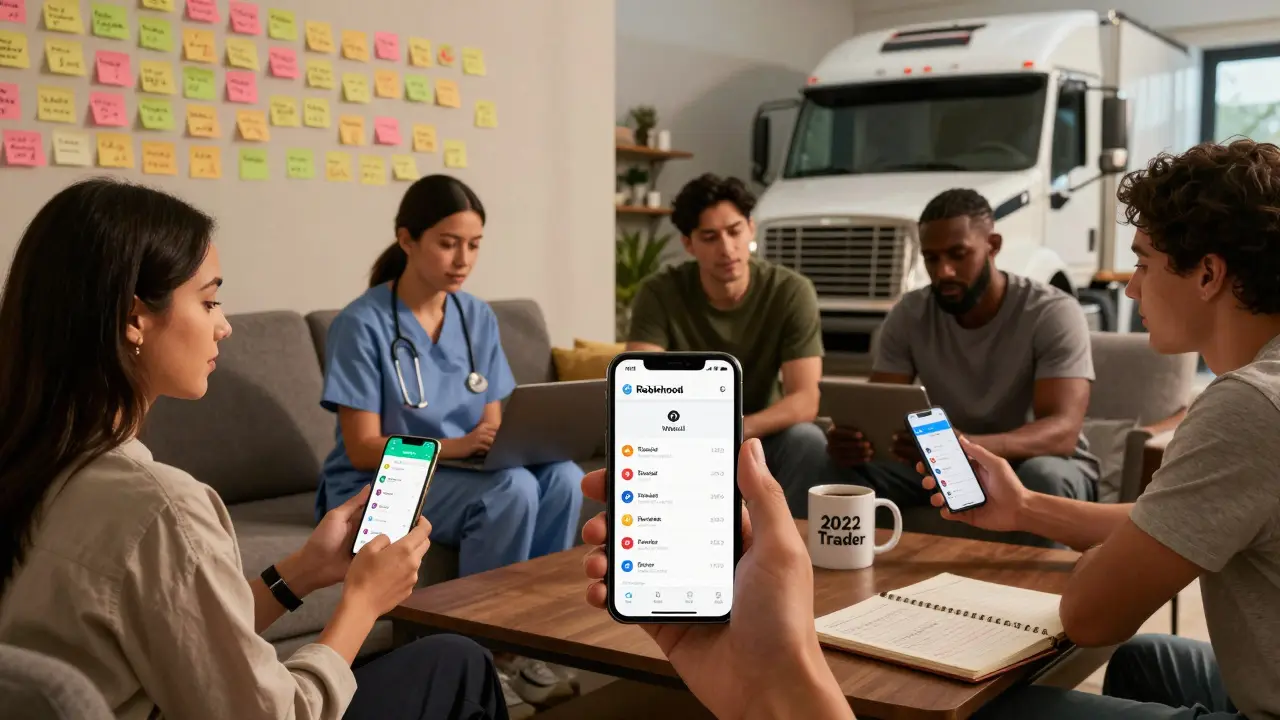
Back in 2022, the stock market didn’t just move-it exploded. What started as a pandemic-side effect turned into a full-blown financial revolution. Everyday people, not just Wall Street pros, were buying and selling stocks like it was a video game. And the rules changed faster than you could say "meme stock." If you were trading in 2022, you weren’t just watching the market-you were part of it.
Retail Trading Took Over
Before 2022, retail trading was an afterthought. Now, it was the main event. Apps like Robinhood, Webull, and eToro made it dead simple to buy a single share of Tesla or AMC. No minimums. No commissions. Just tap, confirm, and boom-you’re a shareholder. By mid-2022, over 25 million U.S. adults were actively trading stocks, up from 14 million in 2019. That’s not just growth-it’s a demographic shift.
These weren’t just college kids gambling on Dogecoin. Teachers, nurses, truck drivers-they all had positions. One survey found that 68% of new traders in 2022 had household incomes under $75,000. They weren’t chasing get-rich-quick dreams. They were trying to build wealth on their own terms, after seeing how the system had worked for others.
Fractional Shares Became the Norm
Remember when you needed $500 to buy one share of Amazon? In 2022, you could buy 0.03 of a share for $12. Fractional shares didn’t just make high-priced stocks accessible-they changed how people thought about investing. Instead of waiting to save up for a full share, traders started building positions gradually, like saving pennies in a jar.
This shift forced brokers to rethink their entire product design. Robinhood’s "Dollar Amount" buy button became its most-used feature. Platforms started showing portfolio allocations as percentages, not shares. Even mutual funds and ETFs began offering fractional options. The result? More people got into the market, and more people stayed in it.
Meme Stocks Were a Cultural Phenomenon
AMC, GameStop, BlackBerry-these weren’t just tickers. They were rallying points. The 2021 short squeeze wasn’t a fluke. It was a blueprint. In 2022, retail traders didn’t just buy these stocks-they defended them. Reddit threads turned into real-world movements. Twitter hashtags drove volume. News outlets stopped treating them as jokes and started analyzing them as market forces.
AMC hit a market cap of $12 billion in April 2022, even though it was still losing money. Why? Because 3.2 million individual investors owned shares. That’s more than the number of people who owned shares in Ford or General Motors. Meme stocks proved that sentiment, community, and social media could move prices as much as earnings reports.
Algorithmic Trading Got Personal
You didn’t need a hedge fund to use algorithms in 2022. Tools like QuantConnect, Alpaca, and TradingView let anyone build and backtest their own bots. Some traders coded simple strategies: "Buy when RSI drops below 30," or "Sell if volume spikes 200% in 15 minutes." Others used AI-driven signals from platforms like TrendSpider.
By late 2022, over 40% of retail trades on U.S. exchanges were executed by automated systems. Not because they were smarter-but because they were faster. Humans hesitated. Bots didn’t. And in a market where seconds mattered, that edge was everything. Even beginners started using pre-built templates. One trader in Chicago told me he made his first $1,000 profit using a free Moving Average Crossover bot he copied from YouTube.
ESG Investing Moved Beyond Buzzwords
Environmental, Social, and Governance (ESG) wasn’t just for big funds anymore. In 2022, retail platforms started tagging stocks with ESG scores. Robinhood showed a green leaf next to companies with strong labor practices. Webull flagged firms with carbon reduction goals. Traders began filtering portfolios by these metrics-not because they were pressured to, but because they wanted their money to match their values.
Companies noticed. Tesla’s ESG score dropped in early 2022 after labor disputes made headlines. Meanwhile, companies like NextEra Energy saw retail inflows jump 18% in six months. ESG wasn’t a side note-it became a filter, just like price-to-earnings or dividend yield.
Volatility Became the New Normal
2022 wasn’t a bull market. It wasn’t a bear market. It was a rollercoaster with no map. The VIX, Wall Street’s "fear gauge," swung between 15 and 40 more than 30 times that year. Inflation hit 9.1% in June. The Fed raised rates seven times. Crypto crashed. Supply chains broke. And yet, the S&P 500 ended the year down only 19%-a lot, but not catastrophic.
Traders learned to expect chaos. Stop-losses got tighter. Position sizes shrank. Many switched to swing trading instead of day trading. One trader in Atlanta told me he stopped checking his portfolio after 3 p.m. every day. "If I’m not sleeping because of a stock, it’s not worth owning," he said. That mindset shift-accepting volatility instead of fighting it-was the quiet win of 2022.
Regulation Caught Up
By 2022, regulators were no longer playing catch-up. The SEC cracked down on payment for order flow-the practice where brokers like Robinhood got paid by market makers to route trades. They demanded clearer risk disclosures. Brokers had to show how much you could lose, not just how much you could make.
Some platforms responded by adding educational pop-ups. Others paused new account openings. The result? A more cautious, informed crowd. New traders started asking questions: "What’s a limit order?" "What happens if the market gaps down?" The era of "just click buy" was over.
What Worked-and What Didn’t
Traders who won in 2022 didn’t chase hype. They stuck to simple rules:
- Only risk 1-2% of capital per trade
- Use stop-losses religiously
- Track your trades in a journal
- Ignore social media noise after 8 p.m.
Those who lost? They doubled down on losing positions. They believed "it’ll come back." They followed influencers who never disclosed their own losses. One trader I spoke with lost $18,000 on a single meme stock because he thought "everyone else is making money." He wasn’t alone.
The Real Legacy of 2022
2022 didn’t create a new kind of trader. It revealed the old one. The one who was always there-just waiting for the tools to catch up. The one who didn’t need a finance degree to understand risk. The one who saw stocks not as casino chips, but as pieces of real businesses.
What changed wasn’t the market. It was the people in it. More of them. More informed. More empowered. And that’s the trend that lasted beyond 2022.
Were meme stocks a bubble in 2022?
Meme stocks weren’t a bubble in the traditional sense-they were a social movement with financial consequences. Their prices didn’t rise because of earnings or cash flow, but because of community action. AMC’s market cap hit $12 billion in 2022 despite negative profits because over 3 million individuals chose to own it. That’s not irrational-it’s collective behavior. The bubble wasn’t in price; it was in the expectation that these stocks would return to "normal" valuation. They didn’t. And that’s okay.
Is algorithmic trading safe for beginners?
Yes-if you start small and understand what you’re running. Many beginner bots use simple rules like moving average crossovers or RSI thresholds. The danger isn’t the bot-it’s overconfidence. A bot can’t predict a Fed announcement or a CEO scandal. Always test strategies on historical data first. Never automate your entire portfolio. Keep manual control over position sizing and stop-losses. Treat bots like tools, not magic.
Why did fractional shares become so popular?
Fractional shares removed the biggest barrier to entry: cost. Before 2022, you needed $3,000 to buy one share of Amazon. Now, you can buy $10 worth. That changed everything. It let people invest consistently, even on small paychecks. It also made diversification possible-instead of putting all your money into one stock, you could own tiny pieces of 10 different companies. That’s how real wealth building starts.
Did ESG investing actually affect stock prices in 2022?
Yes. Companies with strong ESG ratings saw higher retail inflows, especially among younger traders. NextEra Energy, a renewable energy company, saw its retail ownership jump 18% in 2022. Meanwhile, Tesla’s retail ownership dropped after labor disputes made headlines. ESG wasn’t just a label-it became a filter. Traders began comparing companies not just on performance, but on ethics. That’s a permanent shift.
Should I still trade stocks today based on 2022 trends?
The tools from 2022-fractional shares, mobile apps, algorithmic platforms-are still here. But the hype is gone. What remains is a more mature market. The best approach now is the same as in 2022: trade with discipline, not emotion. Use stop-losses. Keep position sizes small. Focus on learning, not returns. The trends that lasted weren’t the flashy ones-they were the ones that made trading accessible, transparent, and personal.
By 2026, the legacy of 2022 is clear: the stock market isn’t owned by institutions anymore. It’s owned by people. And that’s not a trend-it’s the new normal.

Diwakar Pandey
January 4, 2026 AT 02:52Honestly, the biggest win of 2022 wasn’t the meme stocks or the fractional shares-it was the mindset shift. People stopped seeing trading as a lottery and started treating it like a skill. Took me years to get there, but seeing my neighbor, a school bus driver, actually track his trades in a spreadsheet? That’s the real revolution.
Geet Ramchandani
January 4, 2026 AT 19:14Don’t be fooled by the feel-good narrative. Most of these ‘new investors’ lost their shirts. The platforms made it easy to buy, but didn’t teach them how to sell. Now they’re blaming ‘the system’ when their AMC shares are worth 80% less. This wasn’t empowerment-it was financial malpractice wrapped in a Robinhood logo.
Ajit Kumar
January 5, 2026 AT 05:39It’s disingenuous to call this a democratization of finance. What happened in 2022 was a perfect storm of zero-commission trading, social media amplification, and regulatory inertia. The system didn’t change; it merely allowed unprepared individuals to participate in a casino they didn’t understand. The fact that 68% of new traders earned under $75k doesn’t indicate empowerment-it indicates desperation masked as investing. Financial literacy is not a feature on a mobile app. It’s a discipline, cultivated over time, and it was conspicuously absent from the entire spectacle.
Moreover, the normalization of algorithmic trading among beginners is a dangerous illusion of competence. A bot that triggers on RSI crossings doesn’t comprehend macroeconomic cycles, geopolitical shocks, or liquidity crunches. It simply executes. And when the market gaps down 12% overnight-because the Fed did something unpredictable-the bot doesn’t pause. It liquidates. And the human? They’re left staring at a $15,000 loss wondering why ‘everyone else was winning.’
ESG as a filter? That’s not investing. That’s virtue signaling with a brokerage account. Companies don’t operate on moral ratings; they operate on revenue, margins, and cash flow. If you want to support renewable energy, donate to a nonprofit. Don’t confuse your values with your portfolio strategy. The market doesn’t care about your ethics-it cares about your balance sheet.
And yet, the most troubling aspect of this entire episode is the myth of the ‘retail investor.’ There is no such thing. There are only individuals who have been sold a narrative that they are part of a movement, when in reality, they are the fuel for market makers, hedge funds, and proprietary trading desks who profit from their volume, their confusion, and their emotional reactions. The system didn’t change. It just got better at harvesting human behavior.
So yes, the tools are still here. But the lesson? Stay humble. Stay disciplined. And above all-stop believing the hype. The market doesn’t reward passion. It rewards patience, preparation, and precision.
Honey Jonson
January 5, 2026 AT 12:05Nathaniel Petrovick
January 7, 2026 AT 02:25Man, I remember when I first tried to trade back in 2022. I thought I was Warren Buffett with a phone. Turned out I was just the guy who bought GameStop at $400. But hey-I learned. Now I use stop losses, track every trade, and don’t touch my portfolio after 8. The apps didn’t change me. The losses did.
Pooja Kalra
January 7, 2026 AT 20:42There is a deeper truth here, one obscured by the noise of tickers and charts: the market has always been a mirror. In 2022, it reflected not just economic conditions, but the collective yearning for agency in a world that had stripped it away. People didn’t trade stocks-they reclaimed dignity. The fractional share wasn’t a financial innovation-it was a psychological lifeline. To own a sliver of Amazon, even one cent’s worth, was to say: I am not invisible. I am not powerless. And that, more than any algorithm or ESG score, was the real trend.
Sumit SM
January 9, 2026 AT 02:07Let’s be real-ESG isn’t about ethics, it’s about identity. People don’t invest in NextEra because they believe in wind turbines-they invest because they want to be the kind of person who believes in wind turbines. And that’s fine! But don’t call it investing. Call it self-expression with a brokerage account. The market doesn’t care if you’re woke-it cares if your position is profitable. And if you’re confusing virtue with valuation, you’re not a trader-you’re a moral theatergoer.
Also, why do people keep saying ‘meme stocks were a social movement’? They were a temporary anomaly fueled by Reddit bots, coordinated hype, and zero regulatory oversight. The fact that AMC hit $12B doesn’t mean it was ‘deserved’-it means the system was gamed. And now, the same people who cheered the squeeze are the first to cry when the price drops. Hypocrisy is the new baseline.
Patrick Tiernan
January 10, 2026 AT 16:05Sally McElroy
January 10, 2026 AT 22:08It’s funny how people romanticize 2022 like it was some golden age. The truth? Most of those new traders didn’t know what a limit order was. They didn’t know what a margin call was. They didn’t even know how to spell ‘dividend.’ And now? They’re the ones screaming about ‘Wall Street corruption’ while their portfolio’s been flat for two years. The real legacy of 2022? A generation of people who think they’re investors-but still don’t know how to read a balance sheet.
And don’t get me started on those YouTube bots. Someone copied a Moving Average Crossover from a guy in a basement with a green screen and called it ‘financial freedom.’ No. It’s called gambling with automation. The market doesn’t care how cute your bot’s name is.
Yes, fractional shares made it easier. But easier doesn’t mean smarter. You can give a toddler a Ferrari and it doesn’t make them a driver. It just makes the crash louder.
Patrick Bass
January 11, 2026 AT 19:31The rise of algorithmic trading among retail investors was inevitable. But the real shift wasn’t the tools-it was the normalization of discipline. Traders who survived 2022 didn’t win because they picked the right stock. They won because they stopped checking their portfolios every five minutes. They stopped reacting to every tweet. They stopped believing that volatility was a signal instead of noise. That’s the quiet victory.
Tyler Springall
January 13, 2026 AT 12:06Let me be the first to say this out loud: the entire retail trading boom was a marketing scam engineered by fintech companies desperate for user growth. Robinhood didn’t empower the masses-they monetized their ignorance. Payment for order flow? Fractional shares? ‘Dollar Amount’ buttons? All designed to increase trade frequency. More trades = more revenue. Not education. Not wealth. More volume. And now that the hype has faded, they’re quietly rolling back features and blaming ‘regulation.’ Classic.
Don’t tell me this was about democratization. Tell me why the same platforms that glorified meme stocks are now charging $5 for instant deposits. Tell me why the ‘community’ that saved AMC vanished the moment the SEC started asking questions. This wasn’t a movement. It was a product launch.
Jen Deschambeault
January 14, 2026 AT 05:00You know what I love? That even after all the chaos, people are still showing up. Still learning. Still trying. That’s the real trend-not the stock prices, not the bots, not the hashtags. It’s the fact that a nurse in Ohio now knows what a P/E ratio is. That a trucker in Texas checks his portfolio once a week instead of once an hour. That’s not a fad. That’s growth. And it’s still happening.