
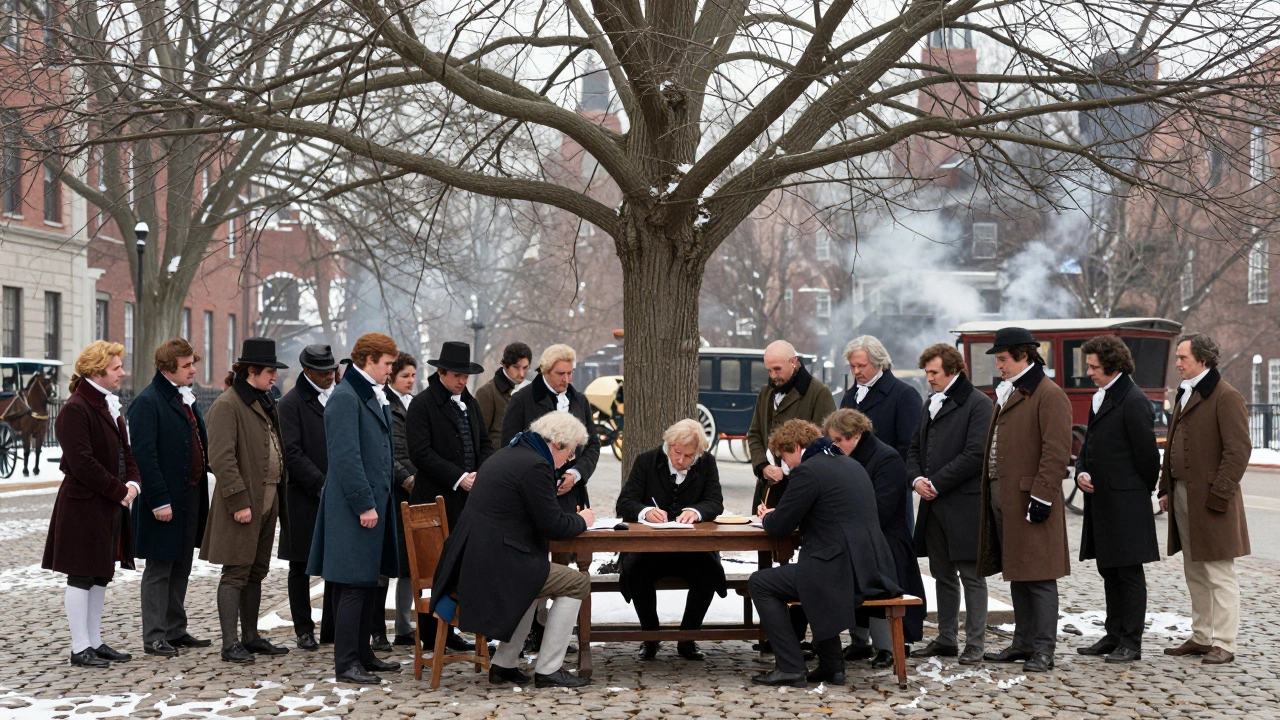
On a cold morning in 1792, 24 stockbrokers gathered under a buttonwood tree on Wall Street to sign an agreement. They were tired of chaotic auctions, unfair commissions, and brokers who didn’t keep their word. That handshake became the foundation of what we now call the New York Stock Exchange. Back then, if you wanted to buy a share of the Bank of New York, you had to show up in person. No phones. No computers. Just face-to-face yelling on a crowded sidewalk.
From Hand Signals to Tickers
By the 1860s, the ticker tape machine changed everything. It wasn’t glamorous-it was a clunky, ink-stained strip of paper that spat out stock prices minutes after trades happened. But for the first time, people could see prices from across town. You didn’t need to be on the floor anymore. A broker in Boston could know what was happening in New York. The ticker didn’t make trading faster-it made it fairer. It reduced the advantage of those who lived closest to the exchange.
Before the ticker, rumors moved faster than prices. A whisper that a railroad company was about to go bankrupt could crash a stock before anyone had proof. After the ticker, prices reacted to real trades, not gossip. By 1900, the NYSE was handling over 1 million shares a day. That’s more than most exchanges traded in a whole month just 30 years earlier.
The Rise of the Floor
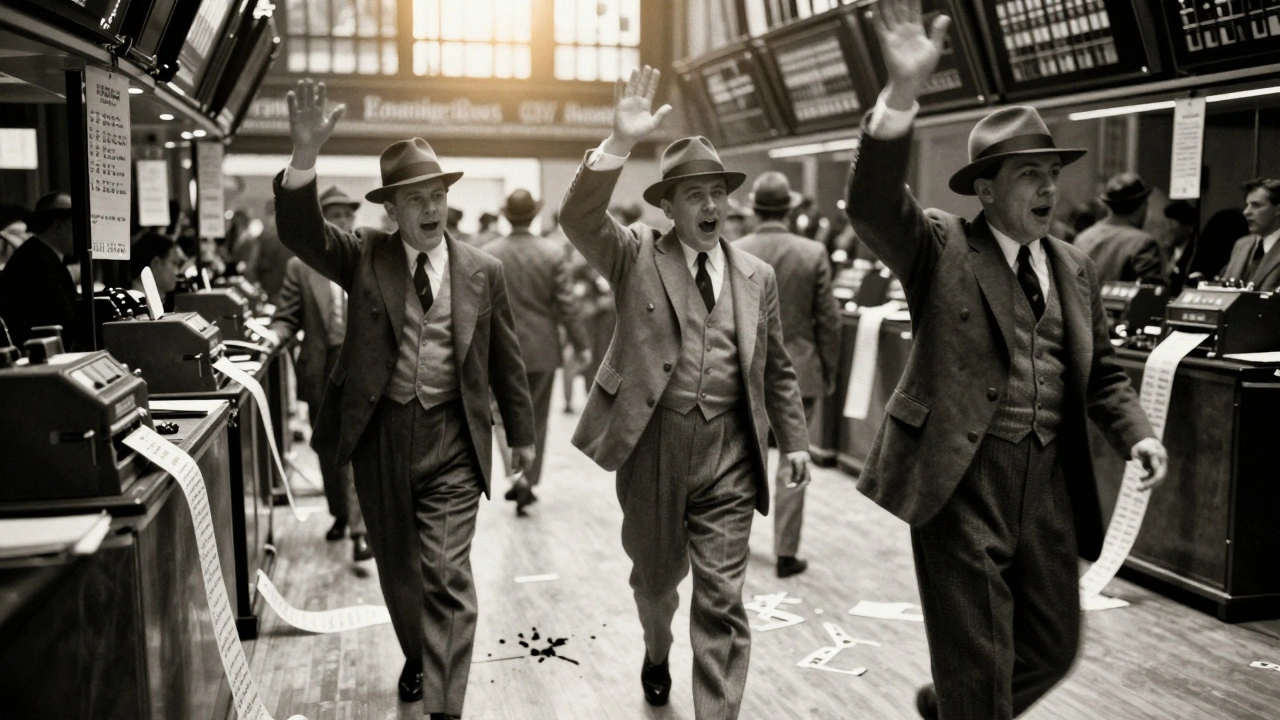
The 1920s were the golden age of floor trading. The NYSE floor looked like a roaring auction house. Brokers in colorful jackets waved their hands, shouted numbers, and used complex hand signals to communicate buys and sells. Each broker worked for a specific firm and represented clients-ordinary people, small businesses, even wealthy families. The system was personal. You didn’t just trade a stock; you built a relationship with your broker.
But the 1929 crash exposed a dark side. Many brokers were pushing risky stocks to clients who didn’t understand them. Some even traded for their own accounts while pretending to act for customers. The SEC was created in 1934 to fix that. Rules forced brokers to disclose conflicts of interest. They had to prove they were acting in their client’s best interest. The floor didn’t disappear, but it became more regulated. Transparency started to matter as much as speed.
Computers Enter the Game
The 1970s brought the first real digital shift. NASDAQ launched in 1971 as the world’s first electronic stock market. Instead of people shouting on a floor, buyers and sellers connected through a computer network. Prices were displayed on screens. Orders were matched automatically. It was slower than the NYSE at first-but cheaper and more open. Small investors could finally get the same prices as big firms.
By the 1990s, online brokers like E*TRADE and Charles Schwab made it possible for regular people to trade from their homes. No more paying $50 per trade. No more waiting for a broker to pick up the phone. You could buy a share of Apple with a click. Trading volume exploded. In 1990, the NYSE averaged 100 million shares a day. By 2000, it was over 2 billion.
The Algorithmic Revolution
By the 2000s, computers didn’t just display prices-they made decisions. High-frequency trading (HFT) firms used super-fast computers to buy and sell stocks in milliseconds. They didn’t care if you held a stock for years. They cared if they could buy it for $100.00 and sell it for $100.01 ten seconds later. HFT made up over 70% of daily trading volume by 2010.
It wasn’t all bad. These algorithms made markets more liquid. Spreads narrowed. It became cheaper for everyone to trade. But they also made crashes faster. In 2010, the Flash Crash sent the Dow Jones down 1,000 points in under 10 minutes. No human pulled the trigger. A single algorithm got confused, sold everything, and triggered a chain reaction. Regulators stepped in with circuit breakers and speed limits on trades. But the machines were here to stay.
Mobile Trading and the Retail Boom
Then came Robinhood in 2013. It didn’t just make trading cheap-it made it fun. No complex charts. No jargon. Just a clean app that let you buy a single share of Tesla with one tap. Gamification turned trading into a social activity. People shared screenshots of their gains. Reddit threads turned meme stocks like GameStop into global phenomena. In 2021, over 18 million new retail trading accounts opened in the U.S. alone. Many were under 30. For the first time, stock trading felt like a normal part of daily life, not something only rich people did.
But the same apps that made trading easy also made it risky. People bought stocks they didn’t understand because they saw a post online. Some lost money fast. Regulators started warning about “social trading” and the blurring line between investing and gambling.
Where Trading Is Today
Today, over 60% of U.S. stock trades happen through algorithms. Humans still make the big decisions-picking which companies to bet on, how much risk to take, when to hold or sell-but the actual execution? That’s all machines. You can trade from your phone, your tablet, even your smartwatch. The cost? Often $0. The speed? Under a second.
But the core of trading hasn’t changed. It’s still about information, timing, and emotion. The tools have evolved, but the human part hasn’t. Greed still makes people chase hot stocks. Fear still makes them sell at the bottom. The floor is gone. The ticker is digital. But the psychology? That’s the same as it was under that buttonwood tree.
What’s Next?
Artificial intelligence is starting to predict market moves before they happen. Some firms are using AI to analyze news, social media, weather patterns, and even satellite images of parking lots to guess how a company’s sales might look next quarter. It’s not magic-it’s math. But it’s getting close.
Blockchain and tokenized stocks are still experimental, but they could one day let you trade fractional ownership of real assets-like a piece of a building or a patent-on a public ledger. Regulation is lagging, but the technology is moving fast.
One thing’s certain: the next big shift won’t be about speed or cost. It’ll be about access. Right now, the best tools still go to those who can pay for premium data feeds and institutional platforms. The next wave of innovation will be about leveling that playing field. Making real-time, intelligent trading tools available to anyone with a smartphone.
Final Thoughts
Stock trading has gone from hand signals on a street corner to AI-driven orders executed in microseconds. But the goal hasn’t changed: to turn money into more money. The tools have become smarter, faster, and more open. But the biggest risk? Still comes from inside your head.
If you’re trading today, you’re part of a 230-year-old story. The machines do the heavy lifting. But you still have to decide what to believe-and when to walk away.

Jeanie Watson
December 10, 2025 AT 03:55Wow, so we went from yelling on a street corner to robots trading in milliseconds. Feels like we’re all just along for the ride now.
Adithya M
December 10, 2025 AT 16:03You missed the part where the SEC allowed HFT firms to colocate servers inside exchange data centers. That’s not fair-it’s institutionalized insider trading. And don’t get me started on how Robinhood sold order flow to Citadel. You think you’re trading? You’re the product.
Tina van Schelt
December 12, 2025 AT 00:45The buttonwood tree was basically the OG Discord server. People gathered, made rules, and called it a day. Now we’ve got AI sniffing out parking lot occupancy to guess if Target’s gonna have a good quarter. We didn’t evolve-we just gave our chaos a Wi-Fi password.
Amanda Harkins
December 13, 2025 AT 11:10I think the real tragedy isn’t the machines. It’s that we stopped seeing trading as a craft. Back then, you learned from your mentor. Now you watch a TikTok and buy a stock because it has a cool logo. We traded knowledge for dopamine.
Jessica McGirt
December 15, 2025 AT 06:16It’s fascinating how the human element hasn’t changed-not the greed, not the fear, not the FOMO. The tools just amplified what was already there. We’re still just animals with spreadsheets.
Jeff Napier
December 15, 2025 AT 17:57They say AI predicts markets but the truth? The Fed’s printing money and the algorithm just follows the cash. Everything’s a puppet show. The ‘market’ doesn’t exist. It’s just a bunch of billionaires feeding data into a black box so they can buy yachts faster than you can say ‘ETF’
Donald Sullivan
December 15, 2025 AT 22:17Mark Tipton’s right about the co-location thing. But let’s be real-Robinhood didn’t ruin anything. It just showed people they were being screwed for 200 years. If you’re mad at the app, you’re mad at capitalism. The app didn’t lie. You just believed the hype.
Mark Tipton
December 17, 2025 AT 19:43Let’s not romanticize the floor brokers. They were gamblers with commission structures. The ticker didn’t make markets fairer-it made them more efficient for the elite. The real revolution was when trading became anonymous. No more face-to-face manipulation. No more ‘I’ll call you back’ lies. The machines don’t care if you’re rich or poor. They just execute. And that’s the only justice we’ve ever gotten.
Ronak Khandelwal
December 17, 2025 AT 22:28Love this breakdown 🙌 From hand signals to AI-what stays constant is that we’re all trying to find meaning in numbers. Maybe the real innovation isn’t the tech-it’s us finally realizing we don’t need to trade to feel alive. You can build, create, connect… and still be rich in ways the market can’t measure 💛
Sibusiso Ernest Masilela
December 19, 2025 AT 02:01Of course you’d write a nostalgic ode to Wall Street. You clearly never worked a real job. The ‘golden age’ was when brokers fleeced widows and orphans with ‘sure thing’ stocks. The only thing that changed is now they do it with algorithms and a clean UI. Same crime. New branding.
Daniel Kennedy
December 21, 2025 AT 01:26Adithya’s spot on about co-location. But don’t blame the tech-blame the regulators who let it happen. The real win? Retail traders now have access. Even if it’s messy, even if it’s emotional-it’s still access. And access is power. We’re not just spectators anymore.
Taylor Hayes
December 21, 2025 AT 19:24I used to work on the floor in the 90s. I remember the smell of coffee and sweat. The yelling. The panic. Now I trade on my phone while waiting for my kid’s soccer practice. It’s quieter. Safer. But sometimes I miss the chaos. Not because it was fair-but because it felt real.
Sanjay Mittal
December 23, 2025 AT 05:16Just a quick note: the 2010 Flash Crash was triggered by a single sell order of E-Mini futures, not an AI gone rogue. The algorithm didn’t ‘get confused’-it followed its logic perfectly. The problem was the lack of circuit breakers. Human error in regulation, not machine error.
Mike Zhong
December 23, 2025 AT 23:22They talk about access like it’s a victory. But if you can’t afford $10k for a data feed or a quant team, you’re still playing with training wheels. The game’s rigged. The machines just made the house edge invisible.