
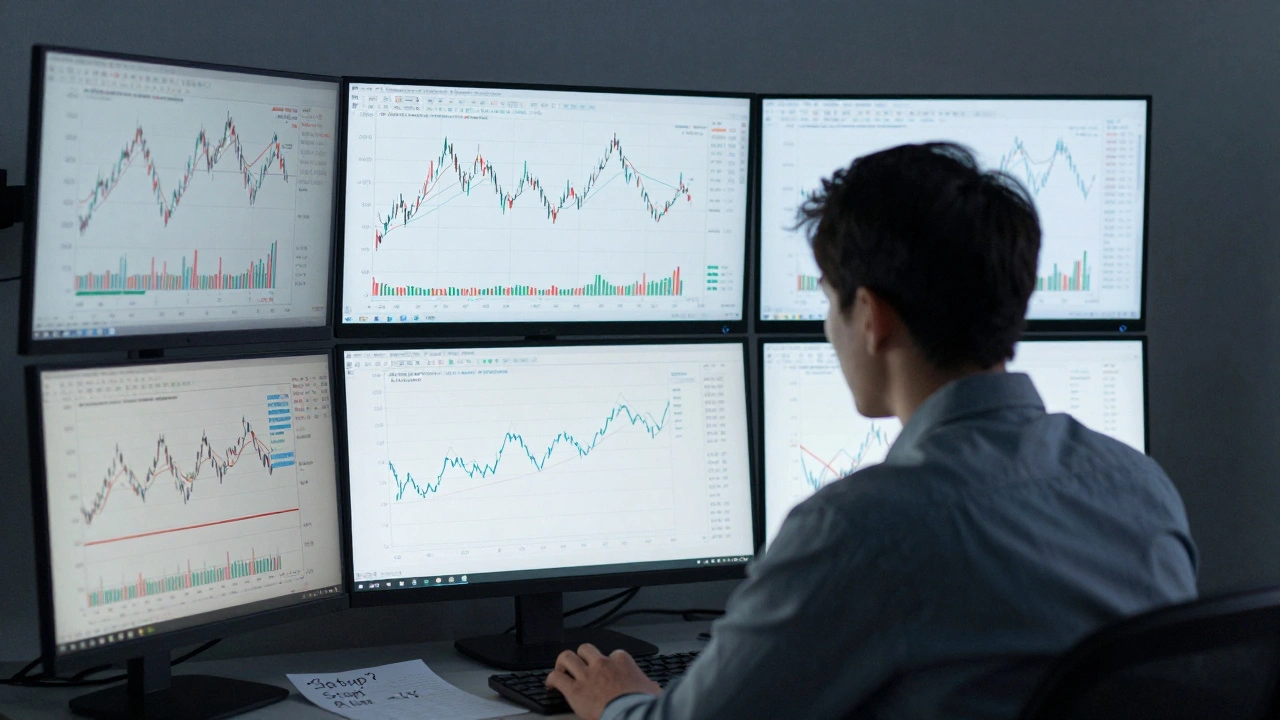
Most people think stock trading is about guessing where prices will go next. That’s not it. Real trading is about recognizing patterns, managing risk, and sticking to a plan-even when your gut screams to do the opposite. If you’ve ever bought a stock because it was trending on social media, then watched it drop 20% in a day, you know how dangerous emotion can be. The right moves aren’t about luck. They’re about systems.
Start with a plan, not a prediction
There’s no magic formula that tells you which stock will go up tomorrow. But there are proven systems that tell you when to buy, when to sell, and how much to risk. A good trading plan answers three questions: What are you looking for? When will you act? And how much are you willing to lose?
Let’s say you’re looking for stocks that break out above their 50-day moving average with rising volume. That’s your setup. You don’t chase every breakout-you wait for the exact conditions. When they appear, you enter. You set a stop-loss at 2% below your entry. You take profit at 5%. That’s a plan. Not a guess. Not a hope. A rule.
Traders who skip this step end up reacting. They see a stock jump 10% and jump in, hoping to catch the next move. But without a plan, they don’t know when to get out. And that’s how losses pile up.
Risk management is your real edge
You don’t need to be right 80% of the time to make money. You just need to lose less when you’re wrong and win more when you’re right. That’s the math behind every successful trader.
Here’s how it works: If you risk $100 on each trade and aim for a $200 profit, you only need to win one out of every three trades to break even. Win two out of three, and you’re ahead. But if you risk $200 to make $100, you have to win two out of every three trades just to stay even. That’s a much harder bar to clear.
Most new traders reverse this. They risk too much to chase big gains. They hear about someone who turned $5,000 into $50,000 in six months and think that’s the goal. But that’s not trading-it’s gambling. The real goal is consistency. Protect your capital first. Let profits grow second.
Use the 1% rule: Never risk more than 1% of your total trading account on a single trade. If you have $10,000, that’s $100 per trade. If you have $50,000, it’s $500. This keeps you alive through losing streaks. And they will come. Everyone has them. The difference between those who quit and those who succeed is who stayed in the game.
Learn to read price, not headlines
News moves markets-but not the way you think. A company announces better-than-expected earnings? The stock might drop. Why? Because the market already priced it in. Or maybe investors were expecting even bigger numbers. The stock price reflects what people believe will happen, not what’s happening right now.
That’s why professional traders focus on price action. What’s the stock doing on the chart? Is it making higher highs and higher lows? Is volume increasing on up days and shrinking on down days? Is it holding support at a key level like the 200-day moving average? These are the real signals.
Ignore the noise. If you’re watching CNBC or scrolling through Twitter for trading ideas, you’re already behind. Real insight comes from watching how price behaves over time. Look at daily and weekly charts. Learn to spot consolidation patterns, breakouts, and reversals. Tools like candlestick patterns, volume spikes, and support/resistance levels give you the edge-not the latest earnings report.

Use technical analysis, not guesswork
Technical analysis isn’t astrology. It’s the study of how buyers and sellers behave over time. It’s based on real data: price, volume, time. You don’t need to know how a company makes money to trade it-you just need to know how its price moves.
Here are three simple tools that work for most traders:
- Support and resistance: These are price levels where the stock has bounced before. Support is where buyers step in. Resistance is where sellers take over. When price breaks through resistance, it often becomes new support. That’s a powerful signal.
- Moving averages: The 50-day and 200-day moving averages are the most watched. When the 50-day crosses above the 200-day, it’s called a golden cross-often a sign of upward momentum. When it crosses below, it’s a death cross. These aren’t perfect, but they help filter noise.
- Volume: A price move without volume is weak. A breakout on high volume? That’s conviction. A rally that fades with shrinking volume? That’s exhaustion.
You don’t need 20 indicators. Use three. Master them. Then add one more. Most traders overload their charts with indicators and end up confused. Simplicity wins.
Trade with discipline, not emotion
The biggest enemy in trading isn’t the market. It’s you. Fear makes you sell too early. Greed makes you hold too long. FOMO makes you buy at the top. Regret makes you re-enter after missing a move.
Here’s what discipline looks like in practice:
- You have a checklist before every trade: Is the setup clear? Is the stop-loss set? Is the risk under 1%?
- You don’t trade after a big loss. You step away. Emotion clouds judgment.
- You don’t revenge-trade. If you lose $500, you don’t try to win it back in the next hour.
- You keep a trading journal. Every trade. Why you entered. What you expected. What happened. What you learned.
Review your journal weekly. You’ll start seeing patterns-not just in the market, but in yourself. Maybe you always buy when you’re bored. Maybe you avoid trades when you’re tired. Those are your weaknesses. Fix them.

Start small. Scale slow.
You don’t need $10,000 to start. You don’t even need $1,000. You need consistency. Many traders blow up their accounts trying to go big too fast. They think they need to make 10% a week to succeed. That’s a trap.
Instead, aim for 1% to 2% a month. That’s not flashy. But over a year, that’s 12% to 24%. Compound that over five years, and you’re looking at 80% to 150% growth-even with modest starting capital. And you’ll still have your account intact.
Use a paper trading account first. Test your strategy for at least three months. No real money. Just practice. See how you react when the market moves against you. See if your plan holds up under pressure.
When you’re consistently profitable on paper, then move to small real trades. $100 here. $200 there. Keep growing slowly. Let your confidence build with your results-not your account size.
What separates winners from everyone else?
Winners don’t have better information. They don’t have insider tips. They don’t wake up at 4 a.m. to catch the news. They have one thing: process.
They follow their plan. They manage risk. They let the market come to them. They don’t chase. They don’t panic. They don’t need to be right every time. They just need to be right enough, often enough, with enough profit to outweigh the losses.
Stock trading isn’t about becoming a genius. It’s about becoming reliable. It’s about showing up, doing the work, and staying calm when everyone else is losing their head.
If you want to make the right moves, stop looking for the next big tip. Start building your system. Write it down. Test it. Refine it. Then stick to it-even when it’s boring. That’s how real traders win.

Zach Beggs
December 11, 2025 AT 04:51Been trading for 5 years and this is honestly the most practical breakdown I’ve seen. No fluff, just the stuff that actually matters. I wish I’d read this when I started.
Kenny Stockman
December 12, 2025 AT 22:111% rule changed my life. Used to risk 10% per trade, lost $8k in 3 months. Now I’m up 42% in 11 months. Patience > luck.
Sarah McWhirter
December 14, 2025 AT 11:45So you’re telling me the Fed isn’t secretly manipulating the S&P with quantum algorithms? 🤔 Or is this just the official story they want you to believe? I mean, if you really think price action is all that matters, why does every big move happen right after a Fed announcement? Coincidence? I think not.
Also, who decided that moving averages are ‘real’ signals? Some guy in 1972 with a slide rule? We’re in 2025. The market’s a neural net trained on panic tweets and hedge fund algorithms. Your 50-day MA is just a ghost in the machine.
But hey, if you wanna believe in fairy tales, go ahead. I’ll be over here watching the dark pool volume.
Antonio Hunter
December 15, 2025 AT 08:52There’s a deeper truth here that most people miss: trading isn’t about winning trades, it’s about becoming the kind of person who doesn’t need to win every trade. It’s a discipline of self-mastery. The chart doesn’t care about your hopes, your fears, or your last meal. It only reflects the collective unconscious of thousands of strangers, all acting on impulse, information, and inertia. Your job isn’t to predict-it’s to observe, to detach, to respond with clarity. When you stop seeing the market as an opponent and start seeing it as a mirror, everything changes. You stop chasing. You stop reacting. You start being. And that’s when the edge appears-not in your indicators, but in your stillness.
Paritosh Bhagat
December 16, 2025 AT 22:29Wait, you’re telling me people actually lose money because they don’t use stop-losses? 😳 I mean, I’ve been trading since I was 14, and I’ve never once used a stop-loss. I just hold until it goes back up. Also, why are you using American terms like ‘moving average’? In India we use ‘trend line’ and ‘support zone’-it’s more poetic. And also, if you’re only risking 1%, you’re not even trying. Real traders risk 20%. That’s how you become rich. I turned ₹5,000 into ₹5 lakhs in 4 months. You’re welcome.
Ben De Keersmaecker
December 18, 2025 AT 14:39Minor correction: the term is ‘death cross,’ not ‘deathcross.’ Also, volume spikes should be defined as a 200%+ increase over the 20-day average, not just ‘high volume.’ Precision matters. That said, the core message is dead-on. Most traders treat the market like a casino. It’s not. It’s a statistical system with behavioral patterns. Learn the math. Respect the edge. Stay humble.
Aaron Elliott
December 19, 2025 AT 22:02While the sentiment is superficially appealing, this entire piece is a rehash of 1990s retail trading dogma. The notion that ‘systems’ outperform intuition in modern markets is empirically dubious. Algorithmic liquidity, dark pools, and high-frequency arbitrage render traditional technical indicators obsolete. Moreover, the ‘1% rule’ is a psychological crutch for those lacking capital. In reality, capital allocation is a function of Sharpe ratio, not arbitrary percentages. One must also consider transaction costs, slippage, and tax implications-none of which are addressed here. This is not trading advice. It is self-help for people who want to believe they can beat the market with a checklist.
Chris Heffron
December 20, 2025 AT 19:11Love this. 😊 Been using the 50/200 MA crossover for 3 years now. Not perfect, but it’s got me through 3 bear markets. Also, journaling saved me. I used to be a total emotional mess. Now I just check my list and breathe. 🙏
Adrienne Temple
December 21, 2025 AT 03:33YES. I started with $200 and just traded 1 share at a time. Took me 8 months to make $50. Felt like a snail. But I didn’t blow up. Now I’m at $800 and still learning. No fancy tools. Just patience. You got this 💪
Sandy Dog
December 22, 2025 AT 23:43Okay but imagine if you followed this advice and then the market crashed because of a tweet from Elon or a war in the Middle East?? 😭 I mean, what if your ‘plan’ gets destroyed by a black swan? I had a 70% win rate for 11 months, then one tweet wiped out my entire year. I cried for three days. My dog left me. My cat stopped making eye contact. I’m not even sure I can trade again. 😢💔
Nick Rios
December 24, 2025 AT 21:40I used to think I needed to be right all the time. Then I lost everything. Now I just show up. I follow my plan. I don’t care if I miss a move. I care that I don’t lose my shirt. This post? It’s the quiet truth most people won’t admit.
Ronak Khandelwal
December 26, 2025 AT 10:34Bro, this is life advice disguised as trading tips 🙏✨ You’re not just learning how to trade-you’re learning how to live. The market is your guru. It doesn’t lie. It doesn’t judge. It just shows you who you really are. When you stop chasing money and start chasing clarity? That’s when the magic happens. I started with nothing. Now I teach kids in Mumbai how to trade with peace. Not profit. Peace. 🌿💛
Jeff Napier
December 27, 2025 AT 23:42Systems are for sheep. The real edge is insider info. You think the 1% rule works? Try trading when your cousin works at Goldman and tells you the Fed’s about to drop a bomb. Then come back and tell me about moving averages. Also, why do you keep saying ‘you don’t need to be right every time’? That’s the whole problem. You’re not trying hard enough. Just go all in. If you’re not risking everything, you’re not playing.
Sibusiso Ernest Masilela
December 29, 2025 AT 22:18This is amateur hour. You speak of ‘plans’ and ‘discipline’ as if the market is a kindergarten. The market is a battlefield. The only rule is dominance. The 1% rule? Pathetic. Real traders risk 10% per trade and compound 5x monthly. You don’t ‘journal’ your trades-you dominate the tape. You don’t ‘wait for setups’-you hunt. You don’t ‘stay calm’-you annihilate hesitation. If you need a checklist to trade, you shouldn’t be in the room. Go back to your paper trading and stop pretending you understand risk.
Sarah McWhirter
December 30, 2025 AT 20:14Wow. So you’re saying the ‘1% rule’ is just a way for the system to keep you small? That’s brilliant. I mean, if everyone followed this, the market would be stable. But then who would profit? The ones who don’t follow rules. The ones who see the pattern behind the pattern. The ones who know the Fed’s printing money because the debt clock is blinking red. You’re not trading stocks. You’re trading narratives. And the biggest narrative? That you can win by playing nice.