
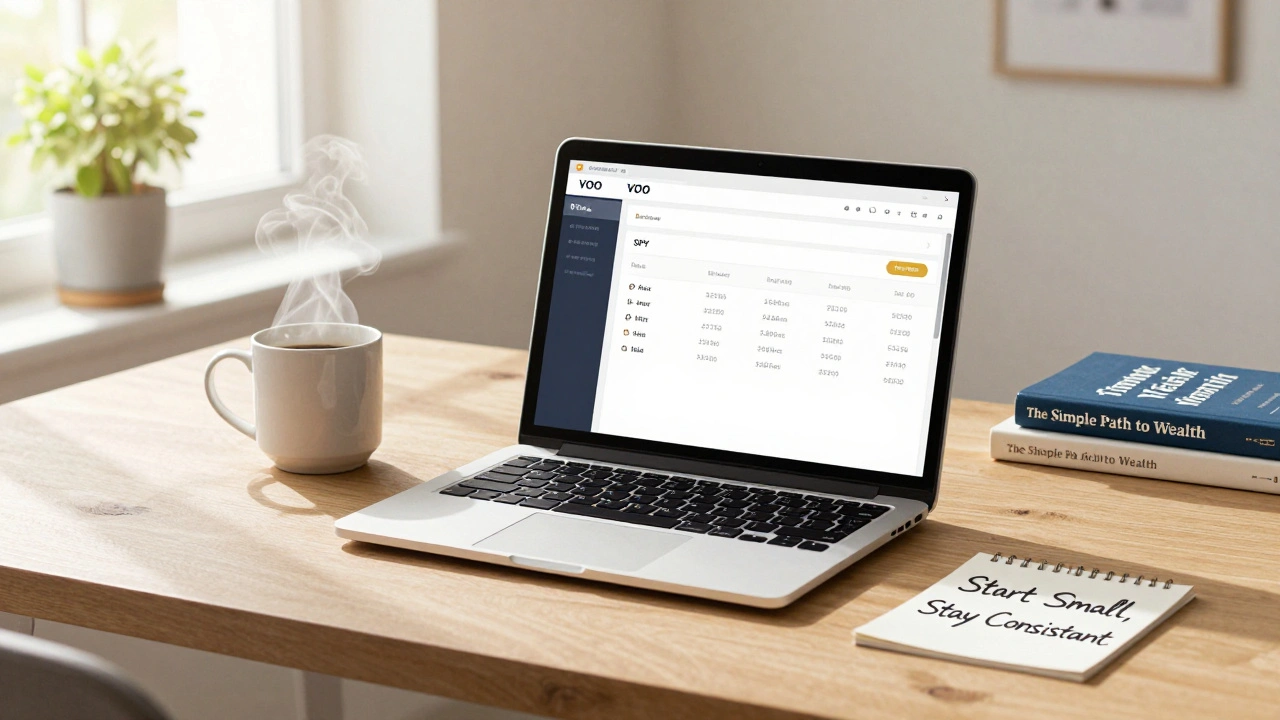
Buying your first stock shouldn’t feel like walking into a casino with no idea how the chips work. Yet that’s how most beginners feel. The good news? You don’t need a finance degree, a Wall Street job, or a $10,000 account to start. You just need to know the basics, avoid the common traps, and take your first step without overthinking it.
Understand what stock trading really means
Stock trading isn’t about guessing which stock will double next week. It’s about owning a tiny piece of a company. When you buy a share of Apple, you’re not betting on a price swing-you’re becoming a partial owner of one of the world’s largest tech companies. That ownership comes with rights, like voting on major decisions and sometimes getting a share of profits through dividends.
Most beginners confuse trading with investing. Trading usually means buying and selling frequently-sometimes within the same day-to profit from short-term price moves. Investing means holding stocks for months or years, betting on the company’s long-term growth. As a beginner, focus on investing first. Day trading is risky, requires constant attention, and even professionals lose money more often than they win.
According to the SEC, over 70% of day traders lose money in their first year. That’s not a statistic to ignore. You’re not here to gamble. You’re here to build something that lasts.
Set up your trading account the right way
You can’t buy stocks without a brokerage account. Think of it like a bank account, but instead of holding cash, it holds your stocks, ETFs, and cash. The good news? Most major brokers now charge $0 commissions. That means you can buy a single share of Amazon or Tesla without paying a fee.
Here are the top three platforms for beginners in 2025:
- Robinhood: Simple interface, no fees, great for learning. But it’s barebones-no research tools or customer support beyond chat.
- Fidelity: Free trades, excellent educational content, real-time data, and 24/7 phone support. Ideal if you want to grow beyond just buying stocks.
- Charles Schwab: Strong customer service, free ETFs, and a user-friendly app. Also offers free financial advice if you have $25,000 or more.
Sign-up takes less than 10 minutes. You’ll need your Social Security number, a government ID, and your bank details to link an account. Once approved, you can deposit money. Start small-$50 or $100 is enough to begin.
Learn to read a stock quote
When you open your brokerage app, you’ll see a screen full of numbers. Don’t panic. Here’s what matters:
- Current price: The last price the stock traded at. Not the price you’ll pay if you buy now.
- Change ($ and %): How much the stock moved today. Up or down.
- Volume: How many shares traded today. High volume means lots of interest.
- Market cap: Total value of the company. Calculated as share price × number of shares. Apple’s is over $3 trillion. A small company might be $50 million.
- P/E ratio: Price-to-Earnings. Shows how much investors are paying for every dollar of profit. A P/E of 25 means you’re paying $25 for every $1 the company earns. Higher isn’t always better-it can mean the stock is overpriced.
Don’t chase stocks just because they’re rising. Look at the company’s business. Does it make something people actually use? Is it profitable? Is it growing? That’s more important than the daily price bump.
Start with index funds, not individual stocks
Most beginners think they need to pick the next Tesla or NVIDIA. They don’t. In fact, most professional investors can’t consistently pick winning stocks. That’s why index funds exist.
An index fund tracks a market benchmark like the S&P 500-the 500 largest U.S. companies. Instead of betting on one company, you own a tiny piece of all 500. That spreads your risk. If one company fails, the rest keep you afloat.
Two low-cost index funds for beginners:
- Vanguard S&P 500 ETF (VOO): Expense ratio of 0.03%. That means for every $10,000 you invest, you pay $3 a year.
- SPDR S&P 500 ETF (SPY): The original, slightly more expensive at 0.09%, but very liquid and widely used.
Buy one of these with your first $100. Hold it. Ignore the daily noise. Over 20 years, the S&P 500 has returned about 10% annually on average. That’s how real wealth builds-not by chasing hot stocks, but by staying in the game.
Never risk money you can’t afford to lose
This is the most important rule. Stock prices go up and down. Sometimes they drop 20%, 30%, even 50% in a year. If you need that money for rent, a car repair, or your kid’s school trip-you shouldn’t be investing it.
Before you buy your first stock, ask yourself: Can I lose this money and still sleep at night? If the answer is no, wait. Build an emergency fund first. Three to six months of living expenses. Put that in a high-yield savings account. Then, and only then, start investing.
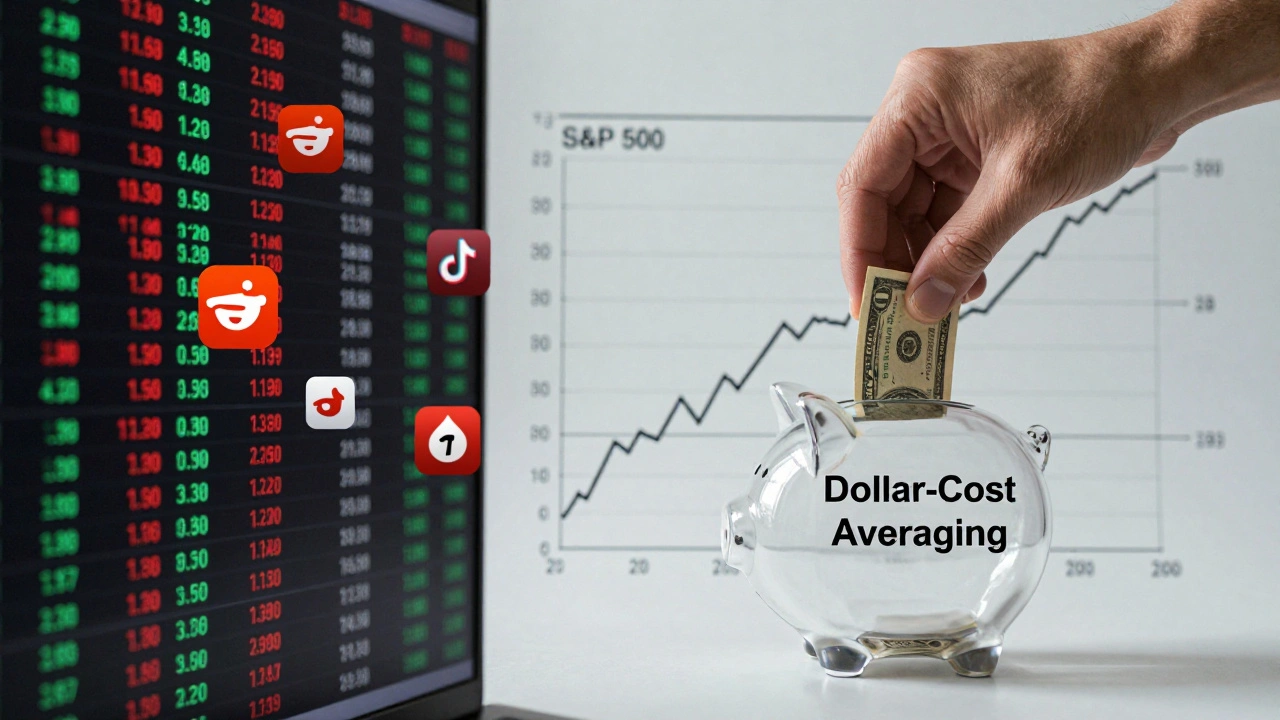
Start with small amounts. $25 a week. $50 a month. Set up automatic transfers. This is called dollar-cost averaging. You buy the same dollar amount every week, no matter the price. When the market drops, you buy more shares. When it rises, you buy fewer. Over time, you smooth out the average cost. It removes emotion from the process.
Learn from mistakes, not memes
Reddit, TikTok, and YouTube are full of people telling you to buy GameStop, Dogecoin, or some obscure penny stock because “it’s going to the moon.” These aren’t investment tips. They’re gambling prompts.
Real investing isn’t loud. It’s quiet. It’s reading a company’s annual report. It’s checking if earnings are growing. It’s asking: Does this business have a moat? Can competitors copy it? Will people still need this product in 10 years?
Here’s a simple habit: Every month, pick one company you’re curious about. Go to their investor relations page (search “[Company Name] investor relations”). Read their latest earnings call summary. Look at their revenue growth over the last three years. You don’t need to understand every line of the report. Just get comfortable reading it.

Keep learning-no one knows everything
The market changes. New companies rise. Old ones fade. The rules don’t change, but the players do. Stay curious. Read one article a week. Watch one short video on basic investing. Use free resources:
- Investopedia: Free tutorials on everything from P/E ratios to options.
- SEC’s Investor.gov: Official U.S. government site with no sales pitch, just facts.
- The Simple Path to Wealth by JL Collins: A short, clear book that’s helped millions start investing.
You don’t need to become an expert. You just need to be consistent. The goal isn’t to beat the market. It’s to not get crushed by it.
What to do next
Here’s your simple 30-day plan:
- Open a brokerage account (Fidelity or Charles Schwab recommended).
- Deposit $50 or $100.
- Buy one share of VOO or SPY.
- Set up a $25 weekly automatic investment.
- Read one article from Investopedia every week.
That’s it. You’re now a stock investor. Not a day trader. Not a gambler. An investor. And you’re on the right path.
Do I need $1,000 to start trading stocks?
No. Many brokers let you buy fractional shares, so you can invest $10 in Amazon or Apple. You don’t need $1,000 to begin. Start with what you can afford-$25, $50, or $100. The key is starting early and staying consistent.
Is stock trading safe for beginners?
It’s safe if you approach it the right way. Buying a single stock you don’t understand? Risky. Investing in a low-cost index fund and holding it for years? One of the safest ways to build wealth. The risk comes from speculation, not from owning shares of solid companies over time.
How long should I hold stocks as a beginner?
Hold for at least five years. The stock market has positive returns over long periods. Short-term swings are normal. If you sell during a drop, you lock in a loss. If you hold, you give your investments time to recover and grow. Most beginners who hold for 10+ years see their money grow significantly.
Should I use a financial advisor?
Not at first. Most advisors charge 1% of your portfolio per year. That means if you have $5,000, you pay $50 a year. For beginners, free tools like Fidelity’s guidance, Investopedia, and books like The Simple Path to Wealth are more than enough. Only consider an advisor when your portfolio grows beyond $50,000 and you need help with taxes or retirement planning.
Can I lose all my money in stocks?
You can lose money on individual stocks if the company goes bankrupt. But if you invest in an index fund like VOO or SPY, you own 500 companies. For all of them to fail at once? Extremely unlikely. The U.S. stock market has recovered from every crash in history. Your risk is minimized by diversification.
Final thought: Start now, not later
Waiting for the perfect time to start investing is the biggest mistake beginners make. There is no perfect time. The market is always uncertain. The best time to start was 10 years ago. The second-best time is today.
You don’t need to be rich. You don’t need to be smart. You just need to begin. Buy one share. Set up one automatic deposit. Read one article. That’s all it takes to start building wealth. The rest? That’s just time working for you.

Jen Deschambeault
December 2, 2025 AT 15:23Just opened my Fidelity account today with $75 and bought my first VOO share. Feels weirdly empowering to own a piece of the whole market instead of gambling on some meme stock. Took me 3 years to get here but I’m finally doing it.
Stop waiting for perfect timing. Just start. Even $25 a week adds up.
Thanks for this guide-it’s the first thing that actually made sense.
Kayla Ellsworth
December 3, 2025 AT 18:46Wow. So you’re telling me the entire financial system isn’t just a pyramid scheme designed to enrich Wall Street while we scrub our pennies together? Groundbreaking.
I’m sure the 70% of day traders who lost money were just too lazy to read a blog post.
Soham Dhruv
December 4, 2025 AT 11:30lol i just bought 0.2 shares of spy with my lunch money
no fees no stress no drama
just putting in 20 bucks every friday and ignoring it til retirement
you dont need to be smart you just need to be consistent
and dont listen to the guys yelling about dogecoin on tiktok
they dont even know what an etsy shop is
Bob Buthune
December 6, 2025 AT 01:22I’ve been in the market since 2008 and let me tell you, the system is rigged. The Fed prints money, banks get bailed out, and ordinary people are told to ‘invest in index funds’ like it’s some kind of spiritual awakening. But who owns the ETFs? Who owns the companies behind them? The same 1% who’ve been gaming this since day one.
VOO? SPY? They’re just digital casino chips with a fancy name. The market doesn’t care if you’re ‘consistent.’ It cares about who controls the algorithms, who owns the data, who owns the media that tells you what to buy.
I’m not saying don’t invest-I’m saying don’t believe the fairy tale. The game is fixed. You’re just being told how to play it nicely so you don’t scream too loud.
But hey, if it helps you sleep at night, go ahead. Buy your shares. Just know-you’re not building wealth. You’re just delaying the inevitable.
Jane San Miguel
December 6, 2025 AT 16:53It’s refreshing to see a piece that doesn’t reduce investing to a motivational TikTok reel. Most ‘beginner guides’ are written by influencers who’ve never read a 10-K. This is refreshingly accurate-especially the distinction between trading and investing. The P/E ratio explanation is textbook-correct. And mentioning Investopedia and SEC.gov? Finally, someone who respects the reader’s intelligence.
That said, I’d argue for adding a brief note on tax-advantaged accounts (IRAs, Roth IRAs) before the 30-day plan. Not everyone has access to a 401(k), and for many, an IRA is the most logical first step. Still, excellent work.
Kasey Drymalla
December 7, 2025 AT 13:50they want you to buy spy because they own spy
they want you to think its safe
but the fed controls everything
the market is a trap
theyll let you make 10% for 10 years then crash it all
you think you own a piece of apple
but apple is owned by the same people who own the fed
theyre gonna take it all
and youll be left with a phone full of apps and no money
gold is the only real asset
buy gold
or youll be poor
Dave Sumner Smith
December 9, 2025 AT 06:30Let me guess-you think Robinhood is fine because it has no fees? They sell your order flow to hedge funds. You think you’re trading for free? You’re the product. Your trades are being front-run. Every single one.
And VOO? It’s just a basket of overvalued tech stocks disguised as diversification. The S&P 500 is dominated by seven companies. That’s not diversification-that’s a monoculture. You’re not safe. You’re just being lulled into a false sense of security while the system quietly siphons your gains.
And don’t get me started on dollar-cost averaging. That’s just a way to make you feel like you’re doing something while you’re slowly being drained.
Real wealth is in cash, land, and private businesses. Not ETFs.
Cait Sporleder
December 11, 2025 AT 04:52While the general sentiment of this article is commendable-particularly its emphasis on long-term, low-cost, passive investing-I find the omission of behavioral finance principles to be a significant oversight. The psychological biases that lead individuals to chase momentum, overreact to volatility, and conflate liquidity with safety are not merely incidental; they are central to why most retail investors underperform the market.
Furthermore, the suggestion to ‘read one article a week’ is insufficient. True financial literacy requires systematic study: understanding the mechanics of compound interest, the implications of inflation-adjusted returns, and the historical performance of asset classes beyond equities. The referenced texts are excellent, but they are entry points, not destinations.
I would also caution against conflating ‘safety’ with ‘low volatility.’ Index funds are not inherently safe-they are simply statistically less likely to fail catastrophically than individual equities. Risk, in all its forms, remains.
Paul Timms
December 12, 2025 AT 18:42This is the best beginner guide I’ve read. Clear, practical, no fluff.
Just started my first $25 weekly into VOO. Feels good to finally be doing something.
Thanks.
Jeroen Post
December 13, 2025 AT 04:33Everyone talks about index funds like they’re magic but no one asks who controls the custodians who hold the underlying assets
Who owns BlackRock who owns Vanguard who owns SPY
It’s all the same people
The system is designed to make you think you’re independent
You’re not investing
You’re subscribing to a financial religion
And the priests take their cut in management fees
And the flock never questions the altar
Wake up
Real wealth is in skills and barter
Not ETFs
Nathaniel Petrovick
December 13, 2025 AT 06:27just wanna say this guide actually helped me
i used to think i needed to be rich to start
now i’ve got 1 share of spy and i’m setting up auto invest
no drama no stress
just putting in 30 bucks every week
and yeah i know it’s not gonna make me rich tomorrow
but it’s better than sitting on my phone watching crypto guys cry
thanks for keeping it real
Honey Jonson
December 13, 2025 AT 09:39omg i just bought my first 0.5 share of voo with my tax refund
i was so scared but then i remembered the 30 day plan and just did it
my mom says i’m wasting money but i told her i’m building a future
and now i’m reading investopedia every saturday
so proud of myself
you guys are the best
love this community
Sally McElroy
December 14, 2025 AT 09:51It’s irresponsible to tell people to ‘just start’ without first emphasizing the moral obligation to be financially literate. Many of these so-called ‘beginners’ are being led into a system that exploits their ignorance under the guise of empowerment. There’s a difference between optimism and recklessness.
And why are we still using the S&P 500 as the gold standard? It’s a cap-weighted index dominated by tech giants with questionable labor practices and tax avoidance schemes. Are we really comfortable investing in companies that outsource jobs, suppress wages, and lobby against regulation?
Investing isn’t neutral. It’s political. And if you don’t ask who you’re backing, you’re not an investor-you’re a participant in a system you haven’t bothered to understand.
Start? Yes. But start with eyes open. Not just with a brokerage app.