
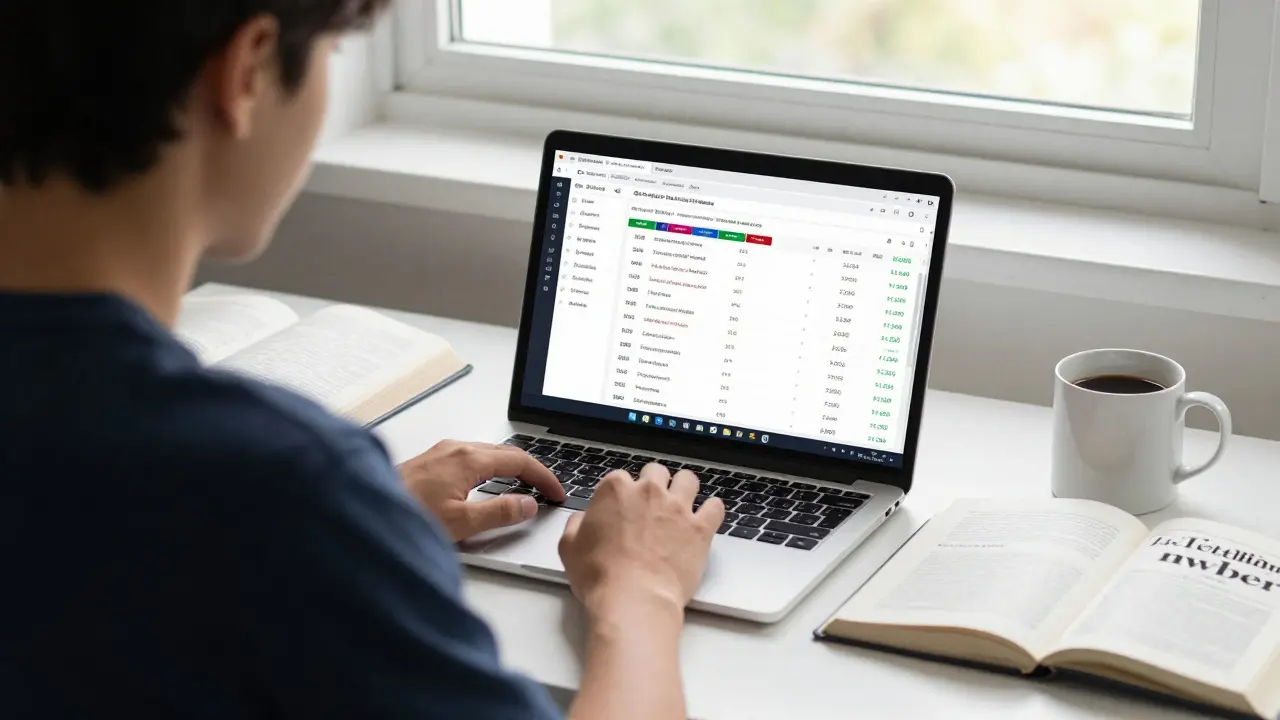
Most beginners think stock trading is about picking the next big winner - a company everyone’s talking about, a chart that looks like a rocket, or a tip from a friend who "made a fortune." The truth? Those approaches lose money more often than they make it. The real winning strategy isn’t about guessing or chasing hype. It’s about consistency, discipline, and understanding what actually moves prices over time.
Start with the basics - not the hype
You don’t need to know how to read candlestick patterns on day one. You don’t need to follow Reddit threads or TikTok traders. What you do need is to understand what a stock actually is: a tiny piece of ownership in a company. When you buy Apple stock, you’re not betting on the next iPhone - you’re betting that Apple will keep making money, grow its customer base, and reward shareholders over years, not weeks.
Most beginners jump straight into buying $500 worth of Tesla or GameStop because they saw a video. That’s like trying to run a marathon without knowing how to walk. Instead, start by learning how markets work. The stock market is a giant auction. Every minute, buyers and sellers agree on a price based on what they think the company is worth right now. News, earnings reports, economic data, even weather patterns can shift that perception. Your job isn’t to predict the future - it’s to understand how people react to information.
Build a simple, repeatable system
The winning strategy for beginners isn’t complex. It’s simple - and that’s why most people ignore it. Here’s the system that works:
- Choose one or two companies you understand - companies whose products you use or whose industry you follow. Think Walmart, Coca-Cola, or Microsoft. Not some obscure crypto-linked startup.
- Buy small amounts regularly - $50, $100, $200 a month. This is called dollar-cost averaging. It means you buy more shares when prices are low and fewer when they’re high. Over time, your average cost per share drops.
- Hold for at least three years. Don’t check your account every day. Don’t panic when the market drops 5%. That’s normal.
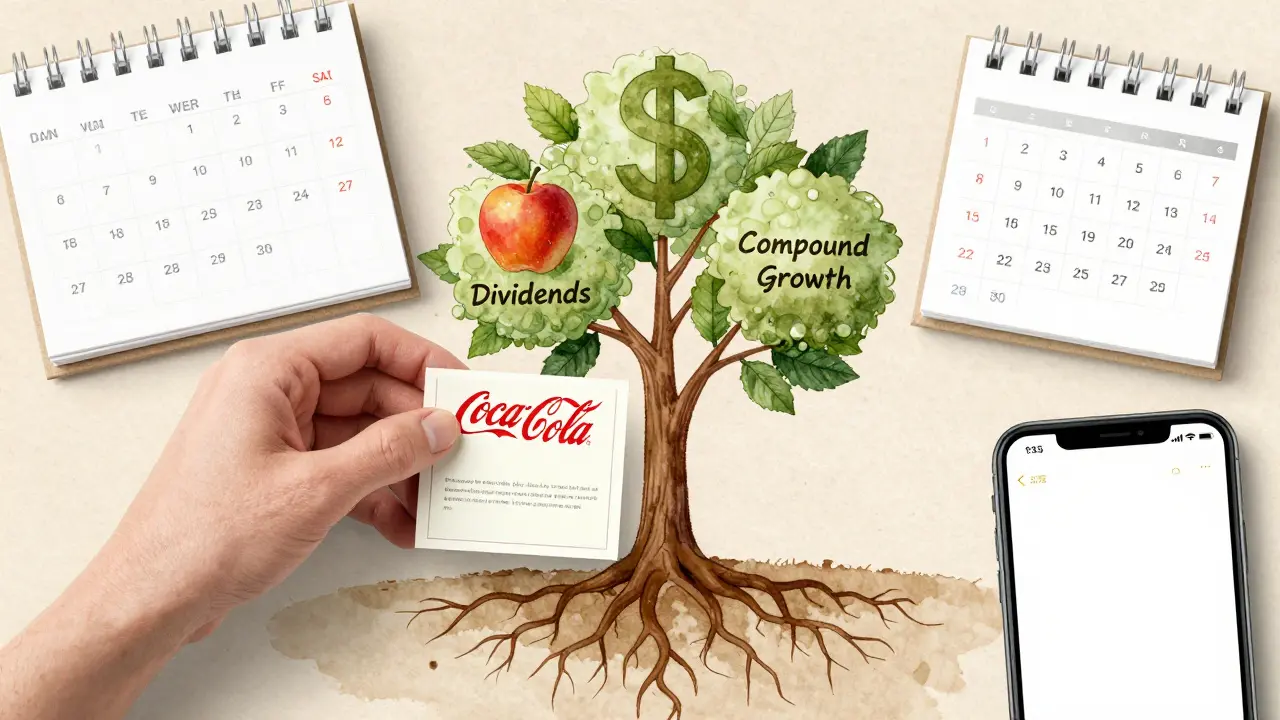
- Reinvest dividends. If the company pays you a portion of its profits (a dividend), use that money to buy more shares. It’s free compounding.
This isn’t flashy. It won’t make you rich in six months. But since 1990, the S&P 500 has returned about 10% per year on average. If you put $200 a month into an S&P 500 index fund and held it for 15 years, you’d have over $75,000 - even with a few crashes in between. That’s the power of time and consistency.
Stop trying to time the market
Every beginner wants to buy low and sell high. The problem? No one knows when low or high is. Even professional investors get it wrong half the time.
Here’s what actually happens: You see a stock drop 15%. You think, "This is my chance!" So you buy. Then it drops another 10%. Now you’re scared. You sell at a loss. A month later, it’s back up. You missed it.
Or you buy a stock because it’s going up fast. You think you’re smart. Then it stalls. You wait. Then it drops 30%. You panic and sell. You lost money. And you didn’t even get to enjoy the rise.
The data doesn’t lie. A 2023 study by Dalbar showed that the average individual investor earned just 3.5% annually over 20 years, while the S&P 500 returned 9.5%. The gap? Emotional decisions. Fear. Greed. Impatience.
Don’t try to time the market. Time the market for you. Set up automatic buys. Stick to your plan. Let the market do its thing.

Use tools - but don’t let them control you
You don’t need fancy software. You don’t need a Bloomberg terminal. You need free tools that help you stay disciplined.
- Robinhood, Fidelity, or Charles Schwab - all offer commission-free trades and easy-to-use apps. Start with one.
- Yahoo Finance or Google Finance - check company earnings, dividend history, and analyst ratings. Look at five years of data, not one week.
- Investing.com or Morningstar - read simple summaries of what’s happening in the economy. No jargon. Just facts.
Ignore the "technical indicators" on TradingView. Ignore the "buy now" alerts. These are noise. They’re designed to make you feel like you’re doing something - even when you’re not.
What you should track: your own behavior. Are you buying because you’re excited? Afraid? Bored? Write it down. After three months, look back. You’ll see patterns. That’s your real edge.
Learn from mistakes - not from gurus
Everyone loses money at first. That’s normal. The difference between winners and losers isn’t knowledge - it’s how they respond to loss.
One beginner I know bought $1,000 worth of a biotech stock because the CEO looked "like a genius" on YouTube. The company had no revenue. Two months later, the stock was down 70%. He didn’t sell. He bought more. Then it went to zero. He lost everything.
He didn’t lose because he didn’t know enough. He lost because he didn’t ask: "Do I understand how this company makes money?" That’s the question you need to answer before every trade.
Instead of watching YouTube gurus, read real books. The Intelligent Investor by Benjamin Graham. A Random Walk Down Wall Street by Burton Malkiel. These aren’t flashy. They’re slow. They’re boring. That’s why they work.
What to avoid at all costs
Here’s the list of traps that destroy beginners:
- Margin trading - borrowing money to buy stocks. It magnifies losses. Don’t do it.
- Options and futures - complex, risky, and designed for professionals. You’re not ready.
- Chasing penny stocks - stocks under $5 are often manipulated. They’re gambling, not investing.
- Following influencers - if someone’s selling you a course on how to "get rich trading," they’re making money from you - not with you.
- Trading too much - every trade costs money. Commissions, spreads, taxes. The more you trade, the more you pay - and the less you keep.
Stick to buying shares of solid companies. Hold them. Let them grow. That’s the strategy.
Progress, not perfection
You won’t get it right the first time. You’ll make mistakes. You’ll feel tempted. You’ll wonder if you’re falling behind.
That’s okay. The winning strategy isn’t about being perfect. It’s about showing up. Every month. Even when you’re scared. Even when the market is down. Even when everyone else is talking about the next big thing.
Start small. Stay consistent. Ignore the noise. Let time do the work. In five years, you’ll look back and realize you didn’t need to be a genius. You just needed to be patient.
Can I start trading stocks with $100?
Yes. Many brokers like Robinhood, Webull, and Fidelity let you buy fractional shares, so you can invest $100 in a single share of Amazon or Google. The key isn’t how much you start with - it’s whether you keep adding money regularly. Even $25 a month, invested over 10 years, can grow to over $5,000 with average market returns.
How long should I hold stocks as a beginner?
Hold for at least three to five years. Short-term trading is risky and expensive. Long-term holding lets you ride out market swings and benefit from compound growth. Companies that consistently grow earnings - like Coca-Cola, Johnson & Johnson, or Apple - reward patient owners over time.
Should I invest in individual stocks or index funds?
Beginners should start with index funds like the S&P 500 (VOO or SPY). They give you instant diversification across 500 companies. If you want to pick individual stocks later, do it with only 10-20% of your portfolio. The rest should be in low-cost index funds. This balances growth with safety.
Is stock trading like gambling?
Only if you treat it that way. Gambling is betting on random outcomes with no analysis. Stock trading becomes investing when you research companies, understand their business models, and hold for the long term. If you’re buying because a meme went viral, you’re gambling. If you’re buying because a company has strong profits, low debt, and growing sales, you’re investing.
Do I need a financial advisor to start trading?
No. Most financial advisors charge fees that eat into your returns, especially when you’re starting small. Use free educational resources from brokerage firms like Fidelity or Vanguard. Learn the basics, build your own plan, and stick to it. You’ll save money and gain confidence faster.
If you’ve read this far, you’re already ahead of 90% of beginners. The market doesn’t reward the loudest or the fastest. It rewards the steady, the patient, and the disciplined. Start today. Don’t wait for the perfect moment. There isn’t one.

Nathaniel Petrovick
January 11, 2026 AT 21:56Man this hit different. I used to chase meme stocks like a fool until I lost my rent money on Dogecoin. Now I just throw $150 a month into VOO and forget about it. My portfolio’s up 60% in 3 years and I didn’t even have to think about it. Seriously, just let it ride.
Honey Jonson
January 13, 2026 AT 17:25so i started with 50 bucks a month like u said and honestly its kinda meditative? like i dont even check my account unless its payday. sometimes i forget i even have stocks. then i look and its like oh cool more money. no stress. no hype. just chill.
Sally McElroy
January 14, 2026 AT 20:18It’s not about patience-it’s about systemic integrity. The market is a construct designed to extract wealth from the uninformed. You don’t ‘let time do the work’-you survive the machine by refusing to play its games. Index funds are a compromise, not a solution. Real wealth is built outside the system.
Destiny Brumbaugh
January 15, 2026 AT 00:00USA made this system work for decades. You think other countries got rich by chasing crypto? No. They stole our tech. We built companies. We held stocks. We didn’t need TikTok gurus. If you’re not buying American giants, you’re letting your money fund the competition. Buy Apple. Buy Microsoft. Buy America.
Sara Escanciano
January 15, 2026 AT 13:11People who say ‘just hold’ are the same ones who told others to buy Lehman Brothers stock in 2007. You’re glorifying passive complicity. The system is rigged. The Fed prints money, billionaires get richer, and you’re told to ‘stay disciplined’ while your wages stagnate. This isn’t investing-it’s conditioning.
Elmer Burgos
January 17, 2026 AT 00:03Hey I just wanna say thanks for this post. I was about to blow my savings on some crypto pump after watching a YouTube video. Then I read this and paused. Took a breath. Started with $25 into SPY. Didn’t feel like a genius. Just felt… calmer. Still learning. Still messing up. But at least I’m not losing everything.
Jason Townsend
January 17, 2026 AT 08:36They don’t want you to know this but index funds are a trap. The government owns 30% of the S&P through ETFs now. Every time you buy VOO you’re funding the deep state. They want you to think you’re investing. You’re not. You’re just a data point in their algorithm. Real money is in gold and land. And cash under the mattress.
Antwan Holder
January 18, 2026 AT 21:41I used to think I was a genius until I lost my entire life savings in 14 days. I thought I was a trader. Turns out I was just a walking emotional wound with a brokerage account. This post didn’t just change my strategy-it saved me from myself. I cried reading it. Not because I lost money. Because I finally saw how lost I was.
Angelina Jefary
January 19, 2026 AT 19:20You wrote ‘dollar-cost averaging’ correctly, but you missed a comma after ‘three years’ in paragraph three. Also, ‘Bloomberg terminal’ should be capitalized as ‘Bloomberg Terminal’-it’s a proper noun. And ‘investing.com’ is not a proper noun, so it shouldn’t be capitalized. Small details matter. Credibility depends on precision.
Jennifer Kaiser
January 20, 2026 AT 15:03There’s a quiet power in not reacting. In not checking your phone every hour. In letting your money grow while you sleep, work, laugh, grieve. The market doesn’t care if you’re watching. It only cares if you’re present. You don’t need to be smart. You just need to be steady. And that’s harder than it sounds.
TIARA SUKMA UTAMA
January 22, 2026 AT 03:46