

Most people think stock trading is for Wall Street suits in suits, or lucky gamblers who got lucky on GameStop. But here’s the truth: if you know what you’re doing, stock trading is one of the few ways a regular person can build lasting wealth without waiting for a raise or winning the lottery. It’s not about day trading like a casino. It’s about building a portfolio that grows over time, pays you dividends, and gives you freedom from the 9-to-5 grind.
What Stock Trading Actually Does for Your Finances
Stock trading isn’t just buying shares and hoping they go up. It’s about owning a piece of a company. When you buy Apple stock, you’re not just betting on the next iPhone-you’re owning 0.0000001% of Apple. That means you get a share of its profits. In 2025, Apple paid out over $17 billion in dividends to shareholders. If you owned 100 shares, you’d get about $150 that year-just for holding on. And if the stock price rises? That’s extra money in your pocket.
Compare that to a savings account earning 0.5% interest. Over 20 years, $10,000 in a savings account grows to about $11,000. The same $10,000 invested in the S&P 500 since 2005? It’s worth over $40,000 today. That’s not magic. That’s compounding.
People who trade wisely don’t chase hot tips. They build systems. They reinvest dividends. They buy when others are scared. And over time, that’s how financial independence happens-not from a side hustle, not from crypto, but from consistent, patient ownership in real businesses.
How to Start Without Losing Everything
You don’t need $10,000 to start. You don’t need a finance degree. You don’t even need to watch the market every hour. All you need is $50, a brokerage account, and a plan.
Here’s how real people do it:
- Open a brokerage account with Fidelity, Charles Schwab, or Robinhood. All of them let you start with $0 minimum.
- Set up automatic deposits. Even $25 a week adds up. $100 a month is $1,200 a year. Invest it without thinking.
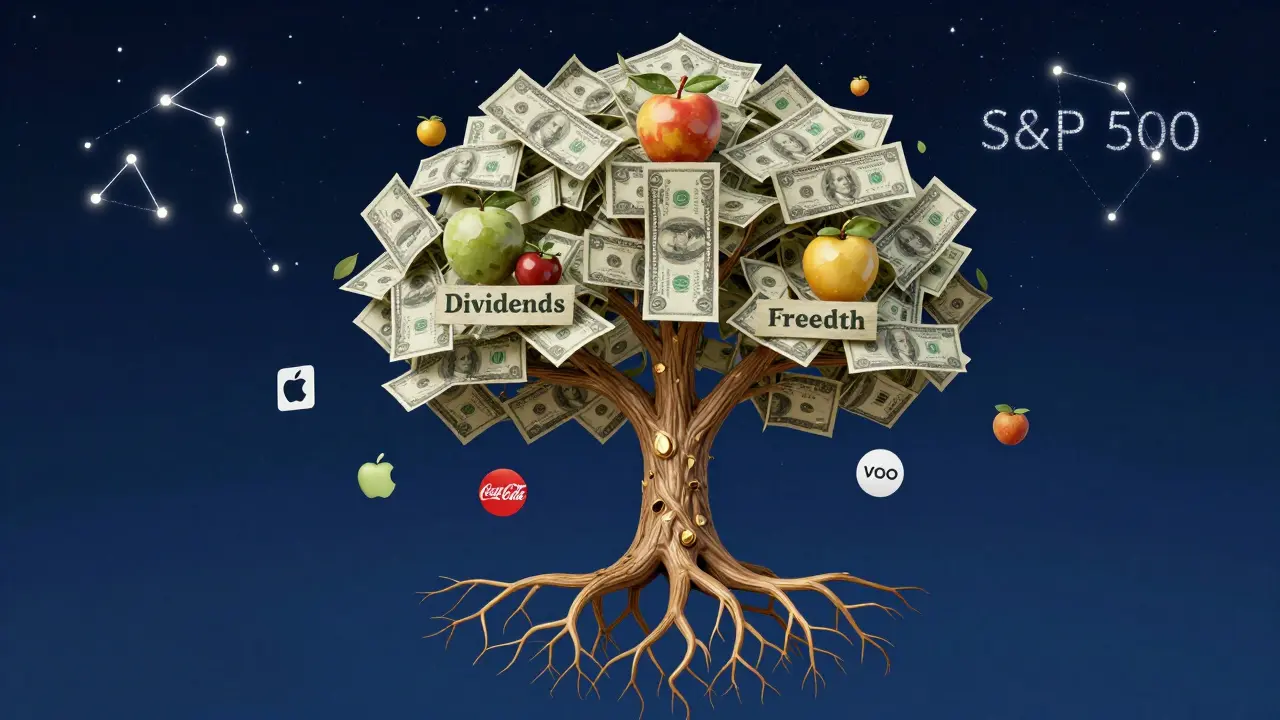
- Buy low-cost index funds first. The S&P 500 ETF (VOO or SPY) gives you exposure to 500 of the biggest U.S. companies. It’s diversified, cheap, and historically returns 10% a year on average.
- After six months, if you’re comfortable, pick one or two companies you understand. Think Coca-Cola, Johnson & Johnson, or Microsoft. Buy a few shares. Watch how they perform.
- Never put more than 5% of your portfolio in a single stock. Even if you’re sure it’s the next Amazon.
Most beginners lose money because they try to time the market. They wait for the perfect moment. They panic-sell when the market drops 5%. The market drops every year. Sometimes it drops 20%. But over 10 years? It always recovers. The trick isn’t predicting the drop-it’s staying in.
The Mindset That Separates Winners from Losers
Here’s the quiet truth: 90% of people who trade stocks lose money. Not because the market is rigged. Not because they’re unlucky. But because they treat it like a video game.
Winners treat it like a business. They track their trades in a simple spreadsheet. They write down why they bought a stock. Did they buy it because the company makes a product they use? Or because their cousin said it’s going to explode? The first reason works. The second? It’s a trap.
One of my clients, a teacher in Milwaukee, started with $200 in 2020. She bought shares in Procter & Gamble because she uses their toothpaste and laundry detergent every day. She didn’t check her account daily. She didn’t care about the daily swing. She reinvested every dividend. By 2025, her $200 had grown to over $600-without lifting a finger. She didn’t quit her job. But now she has extra money every quarter just from owning a piece of a company she already trusts.
Emotion is your biggest enemy. Fear makes you sell low. Greed makes you buy high. Discipline makes you buy when no one else is looking. That’s how you win.

Dividends: The Silent Wealth Builder
Most people think stock trading is all about price gains. But the real magic? Dividends.
Dividend stocks pay you cash-usually every quarter-for owning them. Companies like Coca-Cola, AT&T, and McDonald’s have paid dividends for 50+ years. They don’t need to grow fast. They just need to be stable. And they keep paying.
Let’s say you invest $5,000 in a portfolio of dividend stocks that yield 3.5% annually. That’s $175 a year in cash. Not much? Now imagine you reinvest that $175 every year. In 15 years, you’re not just getting $175-you’re getting over $600 a year. And your original $5,000? It’s probably worth $15,000 by then. That’s compounding on steroids.
Some people build portfolios that pay $1,000 a month in dividends. That’s $12,000 a year. Enough to cover groceries, gas, or a vacation. That’s not retirement. That’s freedom.
What to Avoid at All Costs
There are traps everywhere. Here are the three biggest ones:
- Meme stocks. GameStop, AMC, Dogecoin-these aren’t investments. They’re gambling with a ticker symbol. They have no earnings, no dividends, no real value. They rise because people are excited. They crash when the hype fades.
- Trading every day. Day trading is a full-time job. And most people who do it lose money. The odds are stacked against you. Brokerages make money on your trades. You don’t.
- Chasing hot trends. AI stocks? Electric vehicles? Crypto? Trends come and go. What lasts? Companies that sell food, medicine, software, and essentials. Stick to what you know.
Also, avoid leverage. Don’t borrow money to trade. Don’t use margin unless you’re a professional. One bad trade can wipe out your entire account. That’s not investing. That’s suicide.
Where to Learn Without Getting Scammed
There are thousands of YouTube gurus promising to turn you into a millionaire in 30 days. Ignore them. They’re selling courses, not knowledge.
Real learning comes from:
- The Intelligent Investor by Benjamin Graham-written in 1949, still the best book on value investing.
- Common Stocks and Uncommon Profits by Philip Fisher-about finding great companies, not just cheap ones.
- Reading company annual reports (10-K filings). You can find them for free on the SEC’s EDGAR database.
- Listening to earnings calls. Companies like Apple and Microsoft post them online. Hear what the executives say-and what they don’t say.
Don’t rush. Spend six months learning before you buy your first stock. Read one report. Watch one earnings call. Then buy one share. That’s enough to start.
What Financial Independence Really Looks Like
Financial independence doesn’t mean you quit your job tomorrow. It means you don’t need to work to survive.
Imagine this: You have $300,000 invested in dividend stocks that pay 4% annually. That’s $12,000 a year. Not enough to live on? Add a side gig, or a rental property. Now you’re at $25,000. That’s more than minimum wage. And it’s passive. It keeps coming even when you’re sick, on vacation, or retired.
One woman I know, a nurse in Ohio, retired at 52. She didn’t win the lottery. She didn’t inherit money. She started trading in 2010 with $50 a month. She bought index funds and dividend stocks. She never touched the money. By 2024, her portfolio was worth $420,000 and paid her $16,800 a year in dividends. She works part-time now because she wants to, not because she has to.
That’s the power of stock trading. Not luck. Not timing. Just time, discipline, and consistency.
Start Today. Not Tomorrow.
You don’t need to be rich to start. You don’t need to be smart. You just need to begin.
Open an account tonight. Set up a $25 automatic deposit. Buy one share of VOO. That’s it. That’s your first step. The rest? It’ll follow.
The market doesn’t care if you’re young or old. It doesn’t care if you’re a teacher, a mechanic, or a stay-at-home parent. It only cares if you show up. And if you do, it will pay you back-in dividends, in growth, and in freedom.
Can you really get rich from stock trading?
Yes-but not quickly. Most people who get rich from stocks do it over 15 to 30 years, not 15 months. It’s not about getting lucky on one stock. It’s about consistently investing, reinvesting dividends, and staying calm through market swings. People who do this build real wealth, not paper gains.
How much money do I need to start?
You can start with as little as $50. Many brokers let you buy fractional shares, so you can own a piece of Amazon or Google for under $10. The key isn’t how much you start with-it’s how consistently you add to it. $50 a week adds up to $2,600 a year. That’s the foundation of wealth.
Is stock trading the same as investing?
Not exactly. Trading often means buying and selling frequently, sometimes within the same day. Investing means buying ownership in companies and holding for years. Most people who achieve financial independence are investors, not traders. You want to own businesses, not flip tickets.
What’s the safest way to start trading?
Start with index funds like VOO or SPY. These track the entire S&P 500, so you own 500 companies at once. That spreads your risk. Then, after you understand how the market works, add one or two dividend-paying stocks you understand well. Never put more than 5% of your money in any single stock.
Should I use a financial advisor?
Only if they’re fee-only and fiduciary (legally required to act in your best interest). Most advisors charge 1% of your assets every year. That means if you have $100,000, they take $1,000 annually. You can do the same work yourself for free using low-cost index funds and free educational resources. Save the advisor for complex tax or estate planning, not basic stock investing.
What if the market crashes again?
Markets crash every few years. That’s normal. If you’re buying regularly and reinvesting dividends, a crash is a gift. It lets you buy shares at lower prices. The people who panic and sell are the ones who lose. The people who keep buying are the ones who win. History shows the market always recovers. Your job is to stay in.

kelvin kind
January 7, 2026 AT 20:24Just bought my first share of VOO last week with $27. Feels good to finally start.
lucia burton
January 8, 2026 AT 13:37The real alpha here isn't in the tickers-it's in the behavioral architecture of consistent capital allocation. Most retail participants operate under a cognitive bias of recency heuristic, which leads to mean-reversion traps. When you institutionalize dividend reinvestment and dollar-cost averaging into your financial operating system, you're not gambling-you're engineering long-term optionality. The market doesn't reward volatility; it rewards discipline as a compound function of time. You don't need to predict the next crash-you need to be positioned so that every crash becomes a liquidity event for your portfolio. That's the difference between speculation and ownership.
Peter Reynolds
January 10, 2026 AT 06:25I like how you broke it down. I've been putting $50 a week into VOO since last year. Haven't checked it once since January. My wife thinks I'm crazy but the numbers don't lie.
Fred Edwords
January 10, 2026 AT 15:55Actually, the S&P 500's historical average return is closer to 9.8% annually, not 10%, and that's including dividends reinvested. Also, the phrase 'owning 0.0000001% of Apple' is mathematically imprecise-Apple has roughly 15.8 billion shares outstanding, so 100 shares equals 0.000000633%-but the sentiment is correct. And yes, dividends are the silent engine of wealth. Just don't forget to account for taxes on qualified dividends if you're in a taxable account.
Sarah McWhirter
January 11, 2026 AT 08:51Interesting how you frame this as 'freedom'... but who really benefits? The brokerage firms? The ETF providers? The Wall Street insiders who front-run your trades? You're being sold a fairy tale wrapped in a dividend check. The market is rigged. The Fed prints money, big banks get the first dibs, and you're left buying shares at inflated prices while they short the dip. You think you're building wealth? You're just funding someone else's exit strategy.
Ananya Sharma
January 11, 2026 AT 23:38Let me tell you why this whole 'investing in index funds' thing is a scam perpetuated by financial institutions to keep the masses docile. The S&P 500 is dominated by seven tech giants-Apple, Microsoft, Nvidia, Amazon, Google, Meta, Tesla. That's it. You're not diversified-you're concentrated in a handful of overvalued monopolies that are propped up by liquidity injections and AI hype. Real wealth is in tangible assets: land, gold, small businesses. And if you're not paying attention to inflation, your '40k' in 20 years will buy you a latte and a sad sandwich. This isn't investing-it's inflation hedging with extra steps.
Ian Cassidy
January 12, 2026 AT 03:29Dividends are the real MVP. I started with Coca-Cola and Johnson & Johnson. Didn't even know what a 10-K was. Just bought what I used. Now I get checks in the mail. Feels like free money.
Zach Beggs
January 13, 2026 AT 04:27Been doing this since 2018. My portfolio's up 210%. I still work my job. I just don't stress about it anymore.
Kenny Stockman
January 13, 2026 AT 12:59First step is the hardest. I remember my first $20 into VOO-I was shaking. Now I set it and forget it. You don’t need to be smart. You just need to be consistent. Keep showing up.
Antonio Hunter
January 15, 2026 AT 08:57There's a quiet dignity in this approach. It's not flashy. It doesn't make headlines. But it's the only method that survives generations. I've watched friends chase meme stocks, crypto fads, leveraged ETFs-all gone in 18 months. Meanwhile, the guy who started with $100 a month in 2009? He's retired. Not because he got lucky. Because he refused to be seduced by noise. The market rewards patience like a slow-burning fire. You don't see the flame, but the heat builds. And one day, you realize you're warm.
Paritosh Bhagat
January 16, 2026 AT 08:46Wow, this is so naive. You think dividends are 'free money'? Did you check the tax rate on qualified dividends? Did you factor in inflation? Did you account for the fact that most dividend stocks are held by institutions and you're just the last guy in line? Also, you're ignoring that the S&P 500 is a market-cap-weighted index-so Apple's performance is dragging the whole thing. And you're not even mentioning how many companies in the index are actively buying back shares to inflate EPS-so your 'growth' is manufactured. And don't get me started on the SEC's lack of enforcement on insider trading. You're not building wealth-you're playing a rigged game where the house always wins.
Ben De Keersmaecker
January 18, 2026 AT 02:23One thing people overlook: the real power of dividend investing isn't just the cash-it's the psychological anchor. When the market drops 15%, and you get your $40 dividend check, it reminds you: you're not just betting on price-you're owning a business that's still making money. That's why I keep a printed dividend calendar. It turns abstract numbers into real rhythm. And yes, I read 10-Ks. I read them like novels. I look for footnotes. I look for what's not said. That's how you find the hidden gems.
Aaron Elliott
January 19, 2026 AT 17:12While the sentiment expressed herein is not entirely devoid of merit, one must critically interrogate the epistemological foundations of the underlying assumptions. The notion that 'time and discipline' are sufficient conditions for wealth accumulation presumes a stable macroeconomic environment, which, given the current trajectory of fiscal deficits, debt monetization, and geopolitical instability, is a highly contingent proposition. Furthermore, the historical performance of the S&P 500 cannot be extrapolated into the future without invoking the fallacy of induction. One must also consider the opportunity cost of capital allocation versus alternative asset classes such as private equity, infrastructure, or even collectibles. In short: the argument, while rhetorically compelling, lacks rigorous statistical and structural validation.
Chris Heffron
January 21, 2026 AT 04:08Love this. Just added a few shares of AT&T last week. Got my first dividend check last month-$12. Felt like winning the lottery 😊
Adrienne Temple
January 21, 2026 AT 22:09My mom started with $50 a month in 2015. She didn't even know what ETF meant. Now she gets $800 a year in dividends. She uses it to buy groceries. She doesn't brag. She just smiles. That's the real win.