

Most people think stock trading is for Wall Street insiders or rich folks with time to watch tickers all day. That’s not true. The real secret? Stock trading is a skill - like cooking or driving - and anyone can learn it. You don’t need a finance degree or a six-figure salary. You just need to understand how markets move and how to protect your money while you learn.
Why Stock Trading Matters More Than Ever
In 2025, inflation still bites. Savings accounts earn less than 1% interest. Meanwhile, the S&P 500 has returned about 10% annually over the last 30 years. That’s not magic. It’s compounding. But if you don’t know how to trade - even a little - you’re leaving money on the table.
Think about it: if you put $500 a month into a low-cost index fund and let it grow for 20 years, you’ll have over $350,000. But if you learn to buy when others are scared and sell when they’re greedy, you could hit $500,000 - or more - in the same time. That’s the gap between passive investing and active trading.
Trading isn’t gambling. It’s decision-making under uncertainty. You’re not predicting the future. You’re managing risk, reading signals, and reacting to what the market is telling you right now.
What You Actually Need to Start
You don’t need $10,000. You don’t need fancy software. You don’t need to quit your job.
Here’s what you do need:
- A brokerage account with low fees (think Fidelity, Charles Schwab, or Robinhood)
- At least $500 to begin - yes, even that’s enough
- One hour a week to learn and review your trades
- A notebook (digital or paper) to write down why you bought or sold each stock
That’s it. No indicators. No algorithms. No secret formulas. Just discipline and record-keeping.
Most beginners lose money because they trade too much. They see a stock jump 10% and think, “I need to jump in now!” Then it drops 15% and they panic-sell. That’s not trading. That’s emotional roulette.
The One Rule That Saves New Traders
Rule #1: Never risk more than 1% of your total trading capital on a single trade.
Let’s say you start with $1,000. That means the most you should lose on one trade is $10. If you buy a stock at $20 and set your stop-loss at $18, you’re risking $2 per share. That means you can buy only 5 shares. Five. Not 50. Not 500.
This rule exists because losses hurt more than gains help. If you lose 50% of your money, you need a 100% gain just to break even. One bad trade shouldn’t wipe you out. One good trade shouldn’t make you rich overnight.
Think of it like driving. You don’t floor the gas pedal the second you start the car. You check mirrors, adjust speed, and watch the road. Trading is the same.
How to Pick Your First Stock
Forget “hot tips” from TikTok or Reddit. Those are traps.
Instead, start with companies you know. Not because you like their logo - because you use their product or service.
- Do you buy coffee from Starbucks? Check their stock.
- Do you shop at Target? Look at their earnings reports.
- Do you stream shows on Netflix? See how their subscriber numbers are trending.
Then, go to their investor relations page (it’s free) and read the last two quarterly reports. Look for:
- Is revenue growing? (Not just profits - revenue matters more early on)
- Is debt going up or down?
- Are they buying back shares? (That means they believe in their own value)
If you see three quarters of steady growth and low debt, you’ve found a candidate. Not a sure thing - but a solid place to start learning.
Two Simple Strategies That Work
You don’t need to be a genius. Just consistent.
Strategy 1: Buy and Hold with a Twist
Buy a stock you understand. Hold it for at least six months. If the company keeps growing and you still believe in it - keep holding. If it starts losing customers or piling up debt - sell. No drama.
This isn’t day trading. It’s smart patience.
Strategy 2: The 50-Day Moving Average Rule
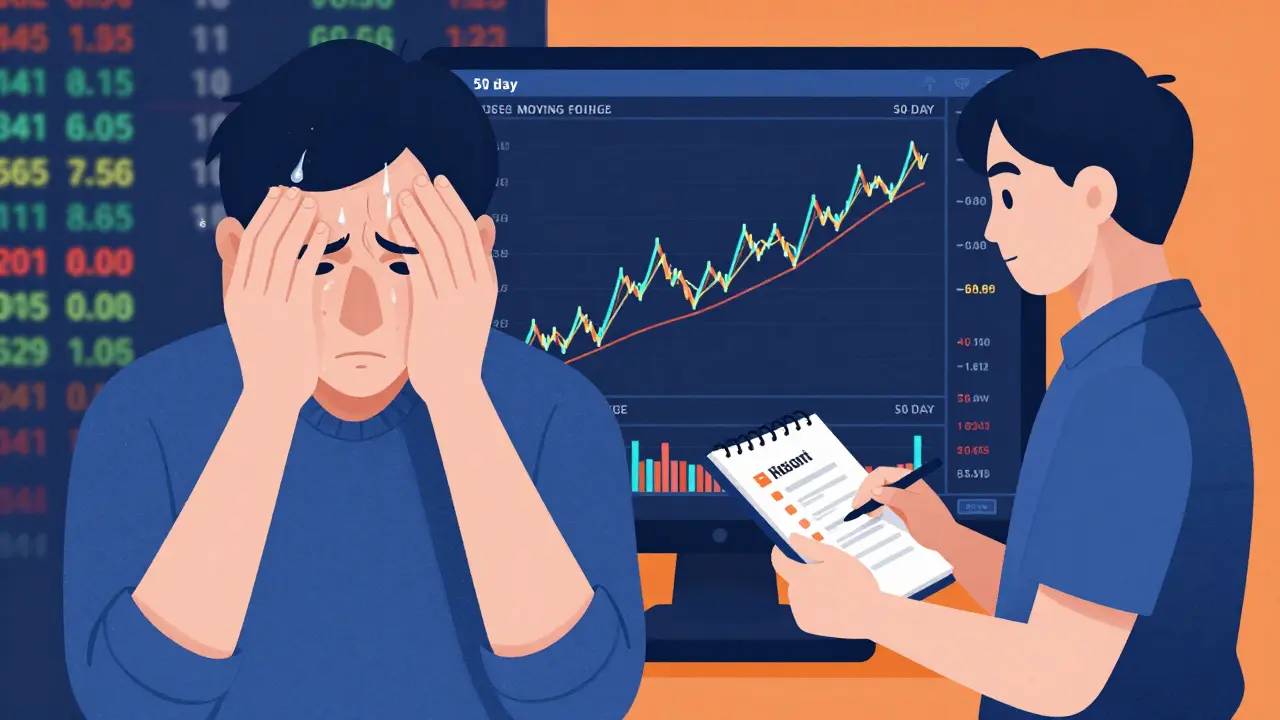
Every stock has a price trend. The 50-day moving average is just the average price over the last 50 trading days. It smooths out the noise.
Here’s how to use it:
- When the stock price crosses above the 50-day line → buy
- When it falls below → sell
It’s not perfect. But it removes emotion. You’re not guessing. You’re following a clear signal.
Back in 2023, Apple’s stock crossed above its 50-day line in January. It rose 40% over the next four months. Someone using this rule would’ve bought and held - and made a solid return without watching the screen all day.
What to Avoid at All Costs
Here are the three biggest mistakes new traders make - and how to dodge them:
- Chasing hype: If everyone’s talking about a stock on social media, it’s probably already priced in. Wait for the pullback.
- Trading on emotion: Fear and greed are your enemies. Write down your plan before you buy. Stick to it.
- Overtrading: The more you trade, the more fees eat your profits. Aim for 1-3 trades a month, not 1-3 a day.
One trader I know in Chicago started with $800. He made 12 trades in his first year. Only three were winners. But he kept his losses under 1% each. By year two, he was up 68%. He didn’t get rich fast. He got rich steady.
How to Measure Your Progress
Don’t judge yourself by how much you made last week. Judge yourself by how much you learned.
Track these three things every month:
- Number of trades made
- Win rate (percentage of profitable trades)
- Average gain vs. average loss
If your win rate is above 50% and your average gain is bigger than your average loss, you’re ahead of 90% of traders.
Even if you’re down 5% this month, if you stuck to your rules and wrote down why you made each decision - you’re winning.

Where to Learn Without Getting Scammed
There are thousands of “gurus” selling courses for $2,000. Don’t buy them.
Here are free, real resources:
- Investopedia: Their stock simulator lets you trade fake money and learn without risk.
- SEC’s Investor.gov: Official, no-fluff explanations of how markets work.
- Yahoo Finance: Free charts, earnings calendars, and analyst ratings.
- Podcasts: “The Investors Podcast” and “Marketplace” give real context without hype.
Read one article a week. Watch one video. Write one note. That’s enough.
Final Thought: Trading Is a Marathon, Not a Sprint
There’s no magic formula. No secret app. No insider group that will make you rich overnight.
What you need is time, discipline, and the willingness to learn from mistakes. The stock market doesn’t care if you’re young, old, rich, or broke. It only cares if you’re consistent.
Start small. Protect your capital. Learn from every trade - even the losing ones. In two years, you won’t just be trading stocks. You’ll be building real financial freedom.
Do I need a lot of money to start stock trading?
No. You can start with as little as $500. Many brokers let you buy fractional shares, so you can invest in companies like Amazon or Google without needing thousands. The key isn’t how much you start with - it’s how consistently you learn and stick to your plan.
Is stock trading the same as investing?
They’re related but different. Investing usually means buying and holding assets for the long term - like index funds or blue-chip stocks. Trading involves more frequent buying and selling, often based on short-term price movements. You can do both. Many people invest in a core portfolio and trade a small portion for extra growth.
Can I trade stocks while working a full-time job?
Absolutely. Most successful traders aren’t full-time day traders. They trade after work, on weekends, or during lunch breaks. You don’t need to watch the market all day. Focus on weekly reviews, not minute-by-minute charts. One hour a week of focused learning beats five hours of distracted scrolling.
What’s the biggest mistake new traders make?
They let emotions drive their decisions. They buy because a stock went up fast, and sell because it dropped suddenly. The fix? Write down your plan before every trade - why you’re buying, what price you’ll sell, and what will make you change your mind. Stick to it.
How long does it take to become profitable?
Most people take 6 to 18 months to become consistently profitable. That’s normal. It’s not about being smart - it’s about being patient. The first year is about learning, not making money. If you’re still losing after 18 months, you’re probably trading without a plan. Go back to basics: risk management, record-keeping, and studying real company performance.
Next Steps: Your 30-Day Trading Starter Plan
Here’s what to do in the next 30 days:
- Open a brokerage account (Fidelity or Schwab recommended for beginners)
- Deposit $500 or more - whatever you can afford to lose
- Sign up for Investopedia’s simulator and practice for one week
- Choose one company you use regularly and read its last two quarterly reports
- Set up a simple notebook (Google Docs or physical) to log every trade idea
- On day 30, make your first real trade - buy one share of a company you understand
You don’t need to be perfect. You just need to start.

Lissa Veldhuis
December 20, 2025 AT 00:04Michael Jones
December 21, 2025 AT 21:52allison berroteran
December 23, 2025 AT 15:01Gabby Love
December 25, 2025 AT 09:16Jen Kay
December 25, 2025 AT 17:39Michael Thomas
December 25, 2025 AT 17:43Abert Canada
December 27, 2025 AT 15:32Xavier Lévesque
December 29, 2025 AT 02:31Thabo mangena
December 29, 2025 AT 22:24Karl Fisher
December 30, 2025 AT 20:09Flannery Smail
January 1, 2026 AT 01:00Emmanuel Sadi
January 1, 2026 AT 11:29