
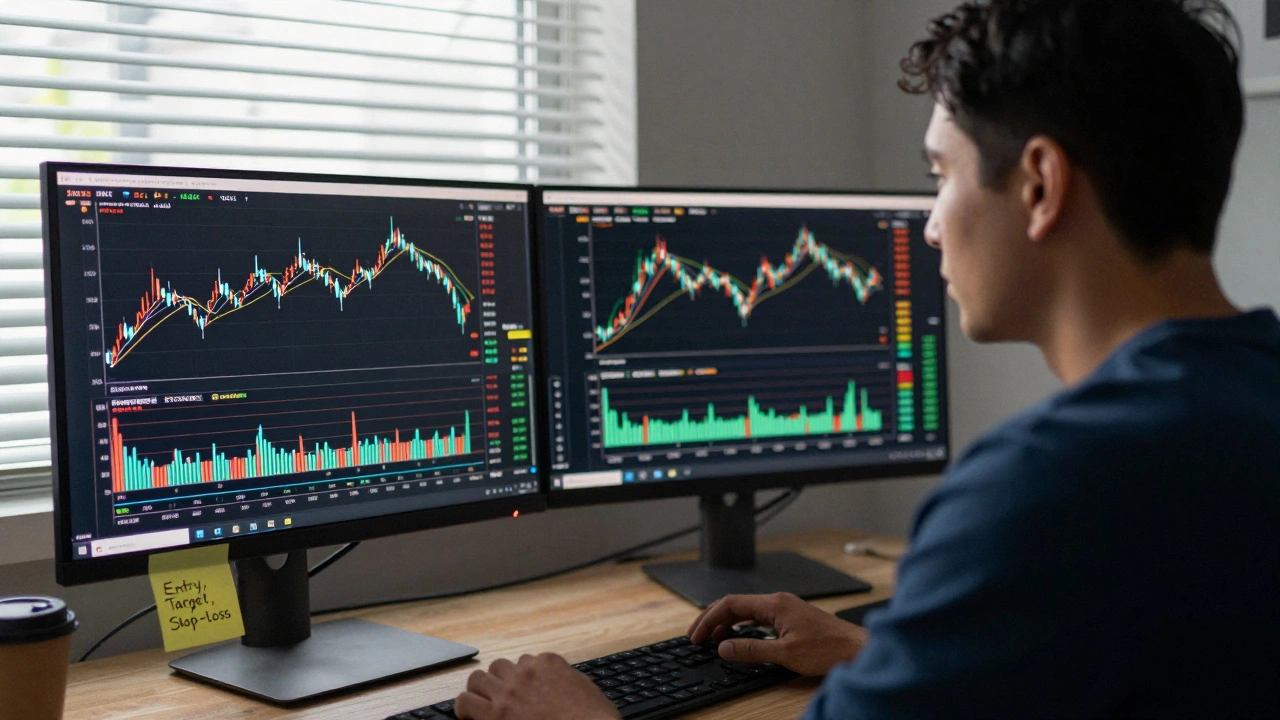
Most people think stock trading is a gamble. They see headlines about someone making a million dollars overnight and assume it’s luck. But the truth? The people who consistently make money in the stock market aren’t lucky-they’re systematic. They don’t chase hot tips. They don’t bet everything on one stock. They use rules, manage risk, and stick to a plan. If you’re tired of watching your savings sit in a savings account earning 0.5% interest, stock trading isn’t just an option-it’s one of the few ways left to build real wealth on your own terms.
Stock trading isn’t about guessing
Forget the movies. No one gets rich by watching CNBC and picking stocks based on what the host says. Real traders don’t rely on gut feelings. They look at data: price patterns, volume spikes, earnings reports, and how the market reacts to news. For example, if a company like NVIDIA reports better-than-expected earnings and its stock jumps 12% on high volume, that’s not luck. That’s a signal. Traders who’ve studied how institutional buyers move into these stocks know what to do next-buy, hold, or sell based on predefined rules.
Think of it like driving. You don’t just step on the gas and hope you don’t crash. You check the mirrors, watch the speed limit, adjust for weather. Stock trading is the same. You need a system. A simple one works best. Many successful traders use a combination of technical indicators like the 20-day moving average and RSI (Relative Strength Index) to spot entries and exits. One trader in Chicago I know uses a 5% stop-loss rule on every trade. He doesn’t care if the stock is Apple or a small-cap biotech. If it drops 5% from his entry, he gets out. No emotion. No hope. Just discipline.
Day trading vs. swing trading: Pick your pace
Not all stock trading is the same. Two main styles dominate: day trading and swing trading. Both can make money, but they demand different time commitments and mindsets.
Day trading means opening and closing positions within the same trading day. You’re not holding stocks overnight. This style works best for people who can sit in front of a screen for 4-6 hours a day, monitor price action, and react fast. It’s not for everyone. The average day trader makes between $500 and $2,000 a month after fees and taxes-unless they’re trading with $50,000 or more. Most fail because they trade too often, ignore risk management, or think they can beat the market every single day.
Swing trading is different. You hold positions for days or weeks, riding price swings between support and resistance levels. You don’t need to watch the market all day. You check your positions in the morning and evening. Swing traders often use weekly charts and focus on stocks with clear trends. For example, if a stock like Tesla has been rising steadily over three weeks with higher lows and higher highs, a swing trader might buy near the 10-day moving average and sell when it hits a previous high. This style is more forgiving. You can miss a few trades and still win over time.
Why most traders lose money-and how to avoid it
According to the U.S. Securities and Exchange Commission, over 80% of retail traders lose money in their first year. Why? Three reasons:
- Overtrading-They feel like they have to be in the market every day. But the best trades often come from waiting. One trader I follow only makes 2-3 trades a month. He waits for setups that match his criteria exactly. That’s it.
- No stop-loss-Not using stop-loss orders is like driving without brakes. If a stock drops 20%, 30%, or 50%, you’re not just losing money-you’re losing confidence. A stop-loss isn’t a sign of weakness. It’s a survival tool.
- Emotional decisions-Holding onto a losing stock because you “believe” in it. Selling a winner too early because you’re scared it’ll drop. These are the two biggest mistakes. You don’t trade based on hope or fear. You trade based on your plan.
One simple fix? Write down your trading plan before you open any position. What’s your entry price? What’s your target? What’s your stop-loss? If you can’t answer those questions, don’t trade. That rule alone separates the winners from the crowd.

Tools you actually need-not the flashy ones
You don’t need a $10,000 trading platform. You don’t need 15 different indicators. You need three things:
- A reliable broker-Look for low commissions, good charting tools, and fast execution. Think TD Ameritrade, Fidelity, or Interactive Brokers. Avoid brokers that push you into options or complex products just to earn more fees.
- A simple charting tool-TradingView is free and powerful. Use it to plot moving averages, volume, and RSI. That’s enough to start.
- A trading journal-This is non-negotiable. Every trade you make, write it down: why you entered, what you expected, what happened, and what you learned. After 20 trades, you’ll start seeing patterns. Maybe you win more on breakouts. Maybe you lose when you trade after earnings. Your journal tells you what works.
One trader I know tracked every trade for 18 months. He found he lost money on every trade made on a Friday. So he stopped trading Fridays. His win rate jumped from 42% to 68%. That’s the power of data-not guesswork.
Start small. Scale smart.
Don’t put $10,000 into your first trade. Start with $500 or $1,000. Use it to learn-not to get rich. Your goal in the first 6 months isn’t to double your money. It’s to not lose it. Trade small positions. Focus on understanding price action. Learn how to read a candlestick chart. Practice with paper trading if you need to. Most professional traders spent a year or more trading in simulation before risking real money.
Once you’ve made 10 profitable trades in a row-without changing your strategy-then consider increasing your position size. Not because you feel confident. Because the numbers say you’re consistent.

Stock trading is a skill, not a lottery
The stock market doesn’t care if you’re rich or poor. It doesn’t care if you went to college or dropped out. It only responds to logic, discipline, and repetition. The people who make consistent money aren’t geniuses. They’re the ones who show up every day, follow their rules, and don’t let emotions ruin their plan.
If you’re serious about making money with stocks, stop looking for the next big tip. Start building a system. Track your trades. Learn from your losses. Stay patient. The market will reward you-not for being loud, but for being steady.
Can you really make a living from stock trading?
Yes, but it’s not easy. Most full-time traders make between $50,000 and $150,000 a year after taxes and expenses. That requires a solid strategy, consistent execution, and at least $30,000-$50,000 in trading capital. It takes 1-3 years of disciplined practice to get there. It’s not a side hustle you do for a few hours a week-it’s a job that demands focus, routine, and emotional control.
How much money do I need to start trading stocks?
You can start with as little as $100 using fractional shares on platforms like Robinhood or Fidelity. But to trade effectively-especially if you want to make meaningful profits-you need at least $1,000-$2,000. This gives you enough room to diversify a bit, manage risk, and avoid being wiped out by one bad trade. Day traders in the U.S. must maintain a minimum of $25,000 in their account due to SEC rules, but swing traders and long-term investors don’t have that requirement.
Is stock trading risky?
Yes, but so is putting money in a savings account with inflation at 3%. The real risk isn’t losing money on a trade-it’s losing money because you didn’t plan. Using stop-losses, sizing positions properly, and avoiding overtrading reduces risk dramatically. The most dangerous traders are the ones who think they’re invincible. The smartest ones know they’re just one bad decision away from a big loss-and they act accordingly.
Do I need to know how to read financial statements?
Not for day or swing trading. Those styles focus on price action and market sentiment, not company fundamentals. But if you’re holding stocks for weeks or months, understanding basics like revenue growth, profit margins, and debt levels helps you avoid companies that are heading for trouble. You don’t need to be an accountant-just know what to look for: rising sales, steady or growing profits, and manageable debt.
How long does it take to become profitable?
Most traders take 6 to 18 months to become consistently profitable. That’s assuming they’re learning from their mistakes, keeping a journal, and not blowing up their account. Some get there faster. Others never do. The difference? The ones who succeed treat trading like a skill they’re building-not a quick fix. They don’t quit after three losing trades. They adjust, learn, and try again.
What to do next
Here’s your next step: Open a brokerage account with $500. Pick one stock you understand-something like Apple, Microsoft, or Amazon. Watch its price movement for a week. Note when it rises and when it drops. Look at the volume. See if it reacts to news. Then, write down one trade you would have made. Did you buy? Sell? Wait? That’s your first lesson. No money risked. Just observation. That’s how every successful trader started.

mark nine
December 10, 2025 AT 02:36Wilda Mcgee
December 10, 2025 AT 10:29Priyank Panchal
December 11, 2025 AT 15:12Tony Smith
December 12, 2025 AT 12:21Jen Becker
December 14, 2025 AT 06:53Rob D
December 16, 2025 AT 06:00Franklin Hooper
December 17, 2025 AT 19:33Jess Ciro
December 18, 2025 AT 03:09Rakesh Kumar
December 18, 2025 AT 23:14Bill Castanier
December 20, 2025 AT 18:31Chris Atkins
December 21, 2025 AT 17:24John Fox
December 23, 2025 AT 06:58Ronnie Kaye
December 23, 2025 AT 10:23Kathy Yip
December 25, 2025 AT 06:37Jen Becker
December 26, 2025 AT 22:12