

Most people think successful investing is about picking the next big stock or timing the market perfectly. That’s not true. The real secret? It’s not about being smart enough to guess what happens next. It’s about being consistent enough to let time work for you.
What Actually Makes an Investment Successful?
Success in investing doesn’t mean doubling your money in six months. It means having enough at 65 to live without worrying. It means watching your portfolio grow slowly, steadily, and without panic during market drops. The people who win aren’t the ones who made the hottest trade. They’re the ones who stayed in the game.
Take the S&P 500. Between 1957 and 2024, it returned an average of 10.5% per year. But if you missed just the 10 best days in that time, your return dropped to 5.5%. Miss the 20 best days? It fell to 3.1%. That’s not luck. That’s patience. The biggest gains happen when you’re not looking.
Start With What You Control
You can’t control the economy. You can’t control interest rates. You can’t control what Apple or Tesla does next quarter. But you can control how much you save, how often you invest, and what you invest in.
Start small. Even $50 a month, automatically invested into a low-cost index fund, adds up. At 7% annual growth, $50 a month becomes over $50,000 in 20 years. That’s not magic. That’s math. And it’s repeatable.
Most people wait until they have a big sum to start. That’s a mistake. The real edge comes from starting early and staying consistent. Time is your strongest ally. Compounding doesn’t care how much you put in-it cares how long you leave it alone.
Why Diversification Isn’t Just a Buzzword
Putting all your money into one stock, one sector, or one country is gambling. It’s not investing. A single company can collapse. A single industry can get disrupted. A single country can face political or economic chaos.
Successful investors spread their risk. That means owning a mix of U.S. and international stocks, bonds, real estate, and sometimes commodities. You don’t need to pick them all yourself. A single fund like a total market index fund holds thousands of companies across dozens of sectors. That’s diversification built in.
And bonds? They’re not boring. In 2022, when stocks fell 20%, U.S. Treasuries rose 5%. In 2023, when tech stocks surged, bonds held steady. Having both helps smooth out the ride. You don’t need to time it. You just need to have both.

How to Handle Market Crashes Without Panicking
Markets crash. They always have. The S&P 500 dropped more than 30% in 2008. It fell 34% in early 2020. It dropped 24% in 2022. Each time, people sold in fear. And each time, those who held on recovered-and went on to make new highs.
Here’s the truth: if you’re investing for the long term, a crash isn’t a disaster. It’s a discount. When stocks fall, you’re buying more shares for the same amount of money. That’s not bad. That’s better.
Think of it like grocery shopping. Would you stop buying milk because the price dropped? No-you’d buy more. The same logic applies to stocks. If you’re adding money regularly, falling prices help you. You just need to keep going.
The Hidden Cost of Active Trading
Day traders, stock pickers, crypto speculators-they make headlines. But the data doesn’t lie. Over 80% of actively managed mutual funds underperform the S&P 500 over 10 years. The same goes for individual investors who trade frequently.
Why? Fees. Taxes. Emotions. Every trade costs money. Every time you sell, you might owe capital gains tax. And every emotional decision-buying because you’re excited, selling because you’re scared-costs you.
Successful investors don’t chase trends. They don’t watch tickers all day. They set up automatic contributions, pick low-cost funds, and forget about it. The best investment strategy is the one you don’t have to think about.
What to Avoid at All Costs
There are three traps most people fall into-and they’re easy to avoid if you know what to look for.
- Chasing performance: If a fund or stock jumped 50% last year, it’s not guaranteed to keep going. Past returns don’t predict future results. In fact, high performers often revert to the mean.
- Trying to time the market: No one consistently predicts when to get in or out. Even professional money managers fail at this. Waiting for the "perfect moment" means you’ll miss the biggest gains.
- Following the crowd: When everyone’s buying NFTs or meme stocks, it’s not a signal-it’s a warning. The crowd is usually wrong at the extremes.
Successful investing is quiet. It’s not flashy. It doesn’t make TikTok videos. It’s just you, your plan, and your discipline.
How to Build Your Simple Investment Plan
You don’t need a financial advisor to start. You don’t need a degree in finance. You just need a basic plan.
- Save first: Aim to put away 10-15% of your income. Automate it. If you can’t do that yet, start with 5% and increase it every year.
- Invest in low-cost index funds: Choose one that tracks the total U.S. stock market (like VTI or FSKAX) and one that tracks international stocks (like VXUS or FTIHX). Keep fees under 0.20%.
- Add bonds as you get older: At 30, maybe 10-20% in bonds. At 50, maybe 40%. Use a bond index fund like BND or VBTLX.
- Rebalance once a year: If one asset class grows too big, sell a little and buy more of the others. This keeps your risk level steady.
- Ignore the noise: Turn off financial news. Unfollow stock influencers. Focus on your plan, not the headlines.
This isn’t complicated. It’s not glamorous. But it works. Millions of people have built wealth this way-without ever picking a single stock.
Real People, Real Results
Meet Sarah. She started investing $200 a month at age 28. She didn’t know much. She just picked a target-date fund and forgot about it. At 45, she had $180,000 saved. She didn’t win the lottery. She just didn’t stop.
Meet James. He waited until he was 40 to start. He put in $500 a month. At 60, he had $220,000. He didn’t get rich overnight. He just didn’t quit.
You don’t need to be rich to start. You just need to start.
Final Thought: It’s Not About Being Right. It’s About Staying In.
The market will go up. It will go down. It will surprise you. But if you’re invested, you’re in the game. If you’re not, you’re watching from the sidelines.
Successful investing isn’t about genius moves. It’s about showing up. Day after day. Year after year. Even when it’s boring. Even when no one’s cheering.
The mystery isn’t hidden in complex formulas or insider tips. It’s in the simple, quiet habits most people ignore.
Can I start investing with less than $100?
Yes. Many brokers like Fidelity, Charles Schwab, and Robinhood let you invest with no minimum. You can buy fractional shares of index funds or ETFs for as little as $1. The key isn’t how much you start with-it’s that you start and keep going.
Should I invest in crypto or individual stocks?
Crypto and individual stocks are high-risk bets. They can make you money fast-but they can also wipe you out. If you want to include them, limit them to 5-10% of your portfolio. Your core holdings should still be low-cost index funds. Those are what build long-term wealth.
What’s the best time to invest?
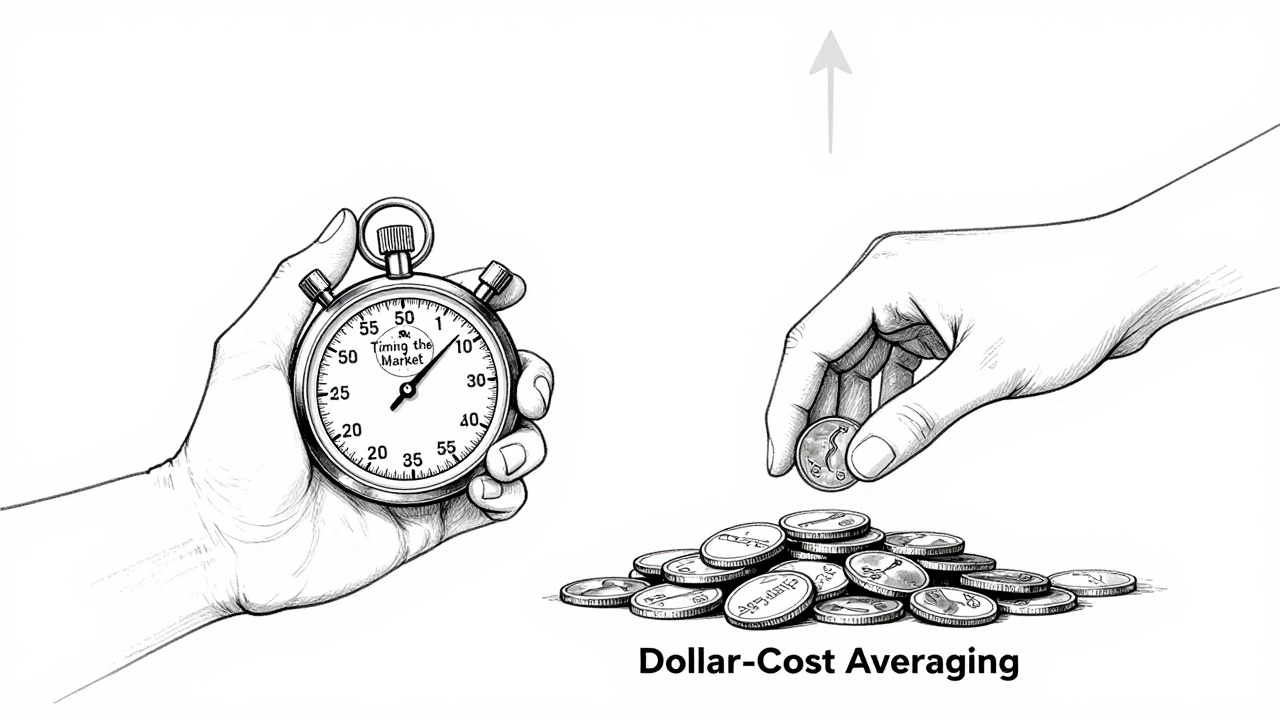
There’s no perfect time. Trying to wait for the "right moment" means you’ll miss the best days. The best strategy is dollar-cost averaging-investing the same amount regularly, no matter the market. That way, you buy more when prices are low and less when they’re high.
How do I know if I’m taking too much risk?
If a market drop makes you want to sell everything, you’re taking on too much risk. A good rule: your bond allocation should roughly match your age. So at 30, 30% bonds. At 60, 60% bonds. That reduces volatility as you near retirement.
Do I need a financial advisor?
Not unless you’re overwhelmed or have a complex situation like multiple businesses or inherited assets. For most people, a simple plan with low-cost index funds and automatic investing is enough. If you do hire one, choose a fee-only fiduciary-someone paid by you, not commissions.
If you’re reading this, you’re already ahead of most people. You’re asking the right questions. Now, take one small step. Open an account. Set up $25 a week. Let it grow. Don’t check it every day. Just let time do its job.

Pramod Usdadiya
December 5, 2025 AT 09:52i read this while sipping chai at 3am and honestly? my brain just stopped screaming about crypto for once. i’ve been putting 500rs every payday into an index fund since last year. not much, but it’s mine. no stress, no notifications, just… growing. 😊
Aditya Singh Bisht
December 6, 2025 AT 21:02THIS. I was waiting for someone to say it like this. I started with $20 a month at 22. Now I’m 31 and I’ve got over $25k. Not rich? Nah. But I don’t panic when the market dips. I just buy more. Time is the real MVP. You don’t need to be a genius. Just consistent. And stop scrolling TikTok finance gurus. They’re selling vibes, not wealth.
Agni Saucedo Medel
December 7, 2025 AT 23:11thank you for writing this 💖 i was about to throw my money into a meme stock because everyone was doing it… then i read this. i’m 26, single, living with my parents, and i just set up automatic $30 transfers to VTI. it feels like a secret superpower. no one knows. no one needs to. i’m just… building. 🌱
ANAND BHUSHAN
December 8, 2025 AT 04:14good stuff. i do the same. monthly deposit. no look. if it goes down, good. more shares. if it goes up, fine. i don’t care. i just keep going. simple.
Indi s
December 8, 2025 AT 05:53my dad used to say ‘money doesn’t sleep, but you should.’ i didn’t get it till now. i started last month with $10. i’m not proud of how late i am, but i’m here. and i’m not stopping. thanks for reminding me it’s not about being first. it’s about not quitting.
Rohit Sen
December 9, 2025 AT 14:03index funds? how 2015. real wealth is in private equity, crypto arbitrage, and leveraged ETFs. you’re just training yourself to be a passive wage slave. but hey, if you like boring, go ahead. I’ll be buying the dip in Dogecoin while you’re checking your 401(k).
Vimal Kumar
December 10, 2025 AT 00:42rohit, i see you. but let’s be real - you’re not making more money from crypto than you are from losing sleep over it. i’ve got friends who blew up on meme stocks and now they’re back to part-time jobs. meanwhile, my buddy who put $100/month into VTI since 2018? He bought his first apartment last year. no drama. no headlines. just math. you don’t have to be a genius to win. just patient. and if you’re reading this, you already are.
Amit Umarani
December 11, 2025 AT 15:59you wrote ‘$50 a month becomes over $50,000 in 20 years’ - that’s wrong. at 7% annual growth, it’s $25,656. you’re off by over 90%. and you said ‘compound doesn’t care how much you put in’ - but it does. More capital = more compounding. fix your math. and stop pretending this is revolutionary. it’s basic finance 101.